

My husband and I are back in California for the summer, at least for one more week. Not Oakland, where we used to live, but in a remote town of 137 people in the Sierras. This place is paradise to me — a caring, close-knit community, incredible natural beauty — but it’s also Paradise, as in Paradise, CA, where 85 people died and 18,804 buildings were destroyed in what remains the deadliest and most destructive single wildfire in California history. To get to our town, you turn off the highway and drive 6 miles of tight switchbacks, descending from a high ridge all the way down to the Yuba River valley. The only other road out of town is unpaved, so if a fire starts on the main road into town, the many RV owners in the town’s two campgrounds will try to leave by the unpaved route, and will likely get stuck, blocking the only viable escape route. My neighbors tell me they’ll stand at the turnoff with shotguns to keep the road clear for vehicles that can handle the terrain, and I don’t doubt them. They’ll do whatever it takes to keep our town from becoming a death trap.
Life here swings between extremes. When I’m lazing on the clear, emerald river (I like to read lying in the water on the standup paddle board that I’ve outfitted with an inflatable back rest) and dragonflies are flitting around, I’m at peace in a way I rarely am anywhere else. But get a whiff of smoke, or hear thunder in the distance (where there’s thunder, there’s lightning, and lightning strikes can ignite brush), or even hear the crackle of the handheld radios we keep charged at all times for evacuation instructions, and my heart starts to race. If I hadn’t fallen deeply in love with the river, the town, and its people, I might decide I’m not built for this stress.
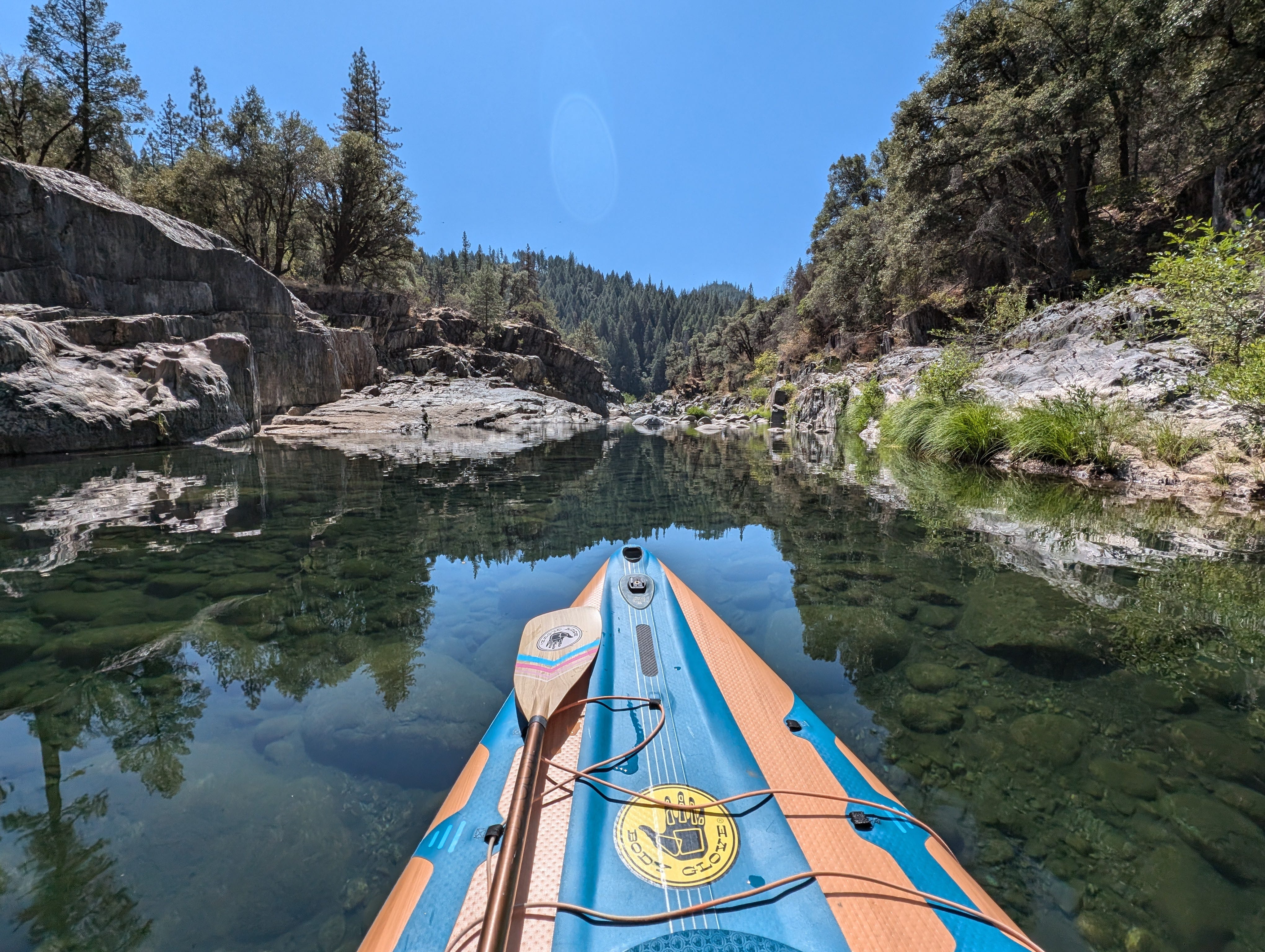
When this was native land, there were about 50 trees per acre. Today, there are about 1500. Native peoples didn’t put out fires — they routinely started them, to clear out the brush and make room for healthy new growth. We now know that fires are necessary for healthy forests, that a century of fire suppression in the West has been disastrous. The fuel load here, and for many miles around, is insane. These are the conditions for mega-fires.
Our modern day version of native fire management is prescribed burns and vegetation treatment (basically other ways of clearing out the underbrush). In 2020, California pledged to treat (meaning burn or otherwise reduce the fuel load) half a million acres a year by 2025; its flagship vegetation program projected 45,000 acres in its first year and completed zero, with another 28,000 approved but never implemented.
I found those stats in a Thomas Hochman post from over a year ago. Here are some other stats from that post. Once the Forest Service initiates a NEPA review, it takes on average 3.6 years to begin a mechanical thinning project and 4.7 years to begin a prescribed burn; for projects that require a full environmental impact statement, those stretch to 5.3 and 7.2 years. Meanwhile the fuel keeps stacking up, and sometimes the fire gets there first. In Berry Creek, critical thinning projects were still tied up in CEQA review when the North Complex Fire came through in 2020 and killed sixteen people. In Grizzly Flats, a forest-restoration project sat in environmental review for nearly a decade; in 2021, two-thirds of the community burned before it was finished. Failing in our prescribed burns we subject ourselves to unprescribed ones — in the forest, and in the government that manages it.
Last weekend, a young couple who run the store in town took us up the mountain in their ATV. We passed a big logging operation, its slash scattered across the ground — the treetops and crowns, the limbs and branches, the bark and needles, and the spindly small-diameter trees that are too crooked, too small, or too low-grade to be worth hauling to a mill. This material has no commercial value, so it is often stacked in piles and burned during the wet winter months. I thought about Charm Industrial, a hard tech startup that takes the slash and instead of piling it up and lighting it on fire, heats it into a thick, carbon-rich liquid called bio-oil (it’s the same compound that gives barbecue sauce its smoke flavor) and injects it deep underground, where the carbon stays locked away for good. Companies pay Charm to do this, because it counts as permanent carbon removal. But the co-benefits are the ones I think about as we bounce past in the ATV: less fuel on the ground, and less of it between our town and whatever might be coming our way as fire season progresses.
Charm is doing a lot of carbon removal now, but we could have been getting the benefits of their technology four years earlier than we did. Before it could inject a single drop of bio-oil, the company had to get regulatory approval, which seems entirely reasonable. But federal rules sort wells into classes (Class I for hazardous disposal, Class II for oilfield waste, Class V for experimental) and bio-oil didn’t obviously belong in any of them. Settling which one it went in took four years. I’m not talking about the time to get the permit — just to settle the question of which permit to apply for. The actual review, once a state regulator agreed to take it on, added another fourteen months. Start to finish, it took five and a half years for what Charm’s founder Peter Reinhardt estimates was about six months of real work.
Peter has done some math on what that wait cost the public. The biomass Charm would have buried over those five years got pile-burned instead — some 30,000 tonnes a year of it, going straight into the air. He puts the health cost of the resulting particulate pollution at around $40 million a year, mostly in asthma and respiratory illness, mostly paid by Medicare and Medicaid, and the full societal cost of the delay in the hundreds of millions. I’m not going to check his math, because I couldn’t, and because that’s not the point. The point is that whatever that cost truly was, it is irrelevant to the regulatory system we have today, even if it is acutely relevant to me and my neighbors in the Sierras.
You might say the regulations written to protect our air and health delivered more smoke, more sick people, and more fire risk for our fragile town. But the regulations themselves certainly don’t mandate a five and a half year delay. Most reasonable people want some sort of approval process before a startup can go shoot something called bio-oil into wells, somebody ensuring that this is actually a good idea, not just some harebrained scheme. (Charm, for what it’s worth, seems pretty well thought through, a sort of win-win-win-win, as described to Robinson Meyer on Heatmap’s Shift Key podcast recently.) We want the protection (you can argue the limits and design), just not the high cost of the protection. The difference is mostly the delay, which stems not necessarily from the regulation itself, but from the incentives in the machinery that administers it.
You might say I go to the Sierras in the summers to escape exactly that. It’s incentives in the machinery of government that I work on, and most of the year now, I do that from our nation’s capital. Now that we have Starlink, I work when I’m here in the mountains, but you get in a different groove when you’re away from the meetings, the receptions, the dinners, the talks, the constant networking. There are exactly two things to do in the evenings after work in our little town: swim, or go to the bar in the charmingly rundown hotel built in 1857 to house miners during the Gold Rush. No one talks about NEPA, or deproceduralization, or even AI at the bar. We talk about whether the town’s volunteer fire department has the equipment it needs, whether smoke from the blazes in Tahoe is headed our way this weekend, the failing health of a neighbor, or the impossibility of getting homeowners insurance. It may be as different from a Dupont Circle happy hour as you can get, but my summers are not really an escape from the machinery of government. Here, I’m closer to the work than anywhere.