

Every mattress has the same tag attached: DO NOT REMOVE THIS TAG UNDER PENALTY OF LAW. Back in the early 1900s, manufacturers stuffed mattresses with all sorts of questionable materials, from horsehair to bugs, and legislators wanted consumers to understand their hidden contents before they rolled off with their new purchase. The penalty of law warning was intended for the sellers, not the buyers. It never applied to us.
This has not stopped generations of Americans from being afraid to remove the tag. To ease our concerns, the tags got a refresh; they now say DO NOT REMOVE THIS TAG UNDER PENALTY OF LAW EXCEPT BY THE CONSUMER. You can go look at yours and check right now, because… you never removed the tag, right? Me neither.
I bring this up because the federal government has spent fifteen years rewording the tag on the Paperwork Reduction Act, and I would like to propose that we stop.
“We don’t need no guidance memos”
For the one person reading Eating Policy who isn’t yet familiar with it, the Paperwork Reduction Act requires agencies to get White House approval, through the Office of Information and Regulatory Affairs (OIRA), before asking the same question of ten or more people. Jen has written before about why it should go and I have cataloged the paperwork explosion it causes. This post is addressed to those of you who believe that more agency guidance, or a little rejiggering or piloting or new blood inside OIRA, can fix the problem, and why I assert it demonstrably cannot.
The PRA is applied far more broadly than it’s written. Wanting to change this through guidance is reasonable, and it’s almost always the right place to start. If OIRA explains, clearly and in writing, what the law doesn’t cover and what collections don’t have to be sent in for its approval, agencies will stop submitting those unnecessary requests, and the most annoying parts of the PRA will shrink to a manageable size. Right?
Except: we have tried this, again and again, and it has not worked.
Example 1: user research guidance
OMB’s own regulation, since forever, has said that “facts or opinions obtained through direct observation by an employee or agent of the sponsoring agency or through nonstandardized oral communication in connection with such direct observations” are not information under the PRA. In other words, user research is not covered by PRA. Watching a veteran try to fill out a form and asking him what he’s thinking is not an information collection. It never was.
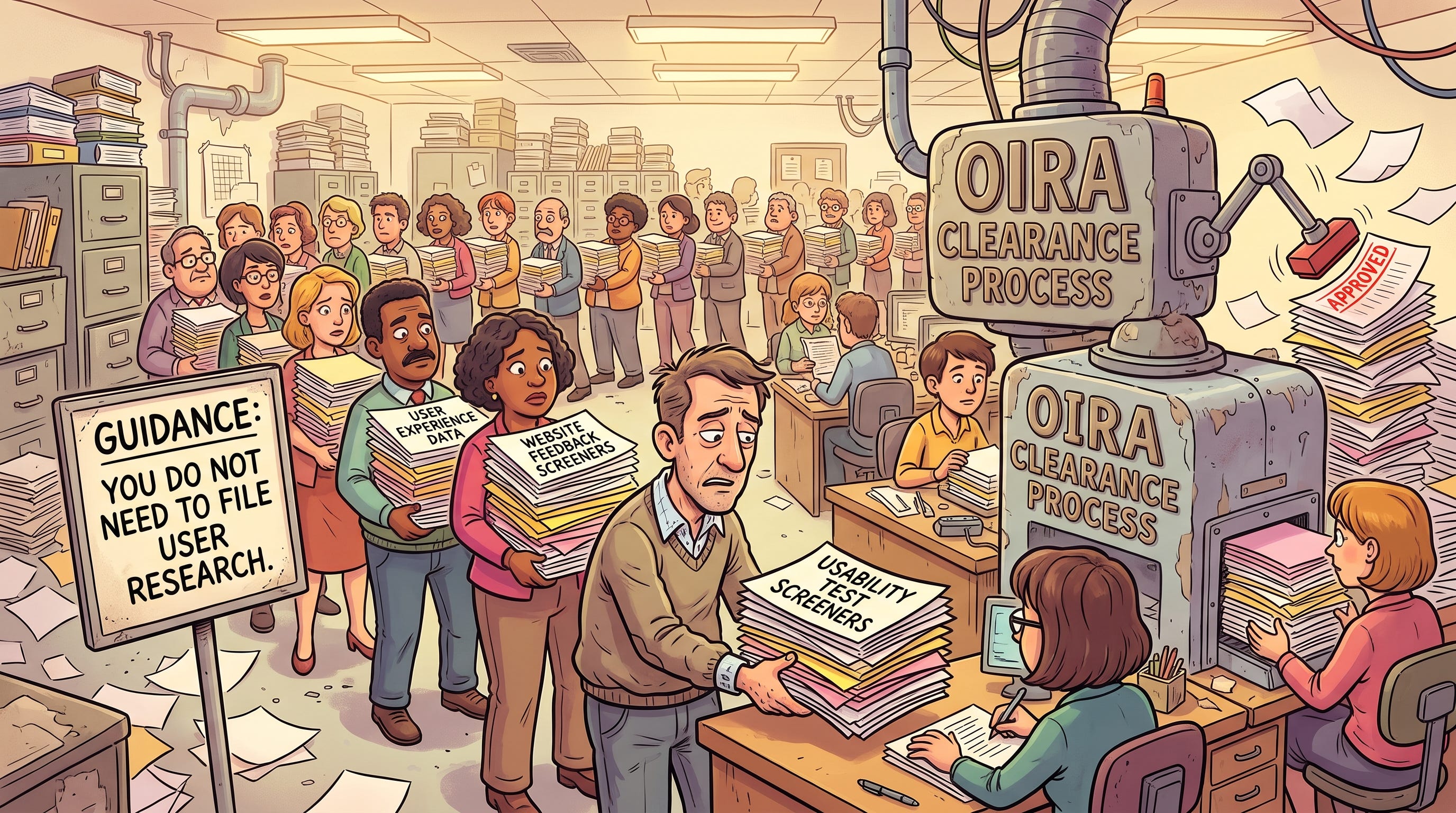
Except civil servants didn’t believe this. In April 2010, OIRA Administrator Cass Sunstein tried to address them by issuing a memo explaining that unstructured feedback, ratings, wikis, and account signups didn’t count as “collections.” In September 2014, OIRA published a table of everything excluded from the definition of “information,” including direct observation. In July 2016, OIRA Administrator Howard Shelanski wrote that an agency that “merely observes a user interacting with a digital services tool or product” and “at most engages in nonstandardized oral communications with the user” is not subject to the PRA. In November 2024, OIRA Administrator Richard Revesz said it again: “usability testing can often be conducted without the need for PRA clearance.”
Four administrators over fourteen years said the same thing in formal guidance. Did it work?
Here’s what the Federal Register looked like recently. The Department of Labor submitted a package of 61 feedback activities in April 2025, including “Quantitative Web User Experience Testing,” tree testing, wireframe testing, and customer interviews. OIRA didn’t sent it back; they approved it. NIST sent OMB a “Generic Clearance for Usability Data Collections” in June 2025, covering 100,000 burden hours, with “usability” right there in the title. NIH’s December 2025 package includes “Website Usability Testing.” Federal Student Aid renewed its “User Experience Design Research Generic Clearance” in March 2026. And in April, the National Agricultural Library asked permission to conduct surveys (estimated to take 8 minutes each) about whether its websites are easy to use.
But my favorite recent Federal Registry entry is from the Patent and Trademark Office. Its September 2025 notice says: “Scripts for usability testing sessions are, in general, exempt from PRA review.” Then it immediately goes on to... submit the screeners it uses to recruit people into those usability testing sessions, at 100,800 burden hours a year. The agency read the guidance telling them they didn’t have to submit this package, quoted it back to OIRA in its submission, and filed it anyway.
And OIRA approved all of it! OIRA has never, to my knowledge, sent a user research package back with a note saying “you didn’t need to file this” (let alone: “stop sending us these, you’re wasting our time and it’s out of our scope.”) It accepts these out of scope requests, processes them, and assigns them control numbers, which in turn signals to every PRA officer in government that filing was the right call.
Why would a PRA desk officer do anything else? Nobody in the history of the Act has been reprimanded for filing something they didn’t have to. The risk runs one way. A memo can’t fix that.
Example 2: lung transplant candidates
In 2022, the doctors who run the national organ transplant system wanted to move one question (whether a patient had prior lung surgery) from the form filled out after a transplant to the form filled out when a patient joins the waiting list. This was so the data might eventually be used to improve future matching models. The network ran its own public comment, and its board approved the change in December 2022.
HRSA, the federal agency that oversees the transplant system, believed it also needed OIRA’s permission before it could move the field. HRSA batches its form changes into one annual package, presumably because each package is so much work, so the approved 2022 lung field change waited until November 2024, when HRSA sent in a whopping 153 forms at once. OMB approved that package in August 2025. The field moved in October 2025, thirty-four months after the transplant network’s board agreed it should.
The VA, the Department of Defense, and the Indian Health Service run the three biggest health systems in the federal government, and none of them ask the White House about healthcare forms at all. Nobody told HRSA it had to, either. But nobody told HRSA it didn’t. This is yet another example of an agency being “careful.”
Meanwhile, twelve people a day die waiting for an organ. Can’t be too careful, now, can we?
Example 3: even the pamphlet is paperwork now
The latest example, which inspired this post, came across my radar last week. (H/T Rebecca Piazza!) USDA’s Food and Nutrition Administration posted a proposed rule to stop SNAP benefit theft, including chip cards, no more magnetic stripes, no more manual vouchers, and card activation on receipt. Great!
Less great: it contains the most expansive reading of “information collection” I have ever seen.
The rule needs EBT processors (the companies that run the card networks for states) to update their software. FNA considers these software changes subject to PRA! “FNA estimates that adding this functionality and implementing the updates would take approximately 160.00 hours per EBT host processor,” it says, “for a total start-up reporting cost of 480.00 hours.” Building a fraud monitoring process “will take the equivalent of a three-week sprint for each EBT host processor,” which is 360 more hours. The rule then notes that “once the EBT host processors add the functionality to their systems, the reporting activities would be automated and would not impose an ongoing burden.” Nothing is reported to anyone. A vendor shipping code is now a proposed federal information collection, even though it is definitely not considered one by even a general reading of the PRA.
It gets better. Twenty-two million households will have to activate their new chip cards, which FNA estimates at five minutes each, “for a total reporting burden of 2,249,365.40 hours.” Reading the notice that a new card is on its way? Another 1.8 million hours. Homeless SNAP recipients walking to an office to pick up a card? 629,822 hours. And then this doozy: “FNA did not previously account for this burden for the distribution of training to households and is including it in this new information collection.” They are now retroactively counting reading the pamphlet enclosed in the envelope with the new card as an information collection subject to PRA!
This package totals to a whopping 63.8 million “responses” and 6.3 million burden hours, none of which, you may notice, involves responding to any information collections.
The rule says these measures are “contingent upon OMB approval under the Paperwork Reduction Act of 1995,” and that FNA “will publish a separate action in the Federal Register announcing OMB’s approval” once it’s received. So this already seriously overdue fix to protect vulnerable recipients from rampant, ongoing theft — a fix that is mandated by Congress — will wait months at best to take effect, waiting for an approval that was never required in the first place.
There is no guidance gap here. OIRA has never told agencies to count software code changes or card activations as information collections. FNA did this all by itself, because the only way to get in trouble under the PRA is to claim too little. And I’ll bet you everything OIRA will approve (as opposed to reject) this package, kicking off a new wave of even more expansive, detailed, and wholly unnecessary requests that further serve to grind government to a halt.
“We don’t need no OIRA control”
This is the cascade of rigidity at play all over again. A PRA officer who reads the 2016 memo and decides not to file a usability study is taking a personal risk, however small, to save the agency nine months. A PRA officer who files anyway is taking no risk at all. OIRA will approve it.
This is why more reform proposals that aim to tune the PRA won’t work. Sure, you could collapse the two comment periods into one, raise the 10 respondent threshold, extend approvals to five years, or write a sixth memo assuring agencies user research is not subject to PRA. Every one of these leaves the window open, and as long as the window is open, agencies will line up at it.
Does the PRA make forms better? No. OIRA has no form designers, no user researchers, and no clinicians. It didn’t know whether “prior lung surgery” belongs on a lung form, and it has no way to know. It readily approved forms Veterans described as a “door blocked with spikes and IEDs.”
Does it stop the government from asking you things it already knows? I wish! This part is even explicitly in the statute: every package an agency submits must certify that the collection “is not unnecessarily duplicative of information otherwise reasonably accessible to the agency.” But OIRA has no capacity to check or request, let alone demand, such alignment. For example, the VA health care application asks a veteran for his household income. The IRS has it. After submission, the VA actually checks the veteran’s answer against IRS data! OIRA sits in the White House, over both agencies. It has never tried to bring the VA and IRS together and mediate a data sharing agreement to obviate the need for veterans to provide information to VA that it can already get from IRS.
Does it protect the public through comment? Many notices get no comments at all, and AI is currently making public comments thoroughly unusable, anyway.
I wish guidance worked here. Half of Hack Your Bureaucracy suggests deploying the exact set of tactics that have been tried here: read the actual law to understand the details, use a thesaurus to reimagine a current process as what you want it to be, and write a persuasive one-pager making your case. But we tried those tactics, multiple times, and it has not changed agency behavior. So it’s time to up the stakes.
Stafford Beer has a term for this: the purpose of a system is what it does. What the PRA does is issue control numbers and add delay. It doesn’t reduce paperwork, doesn’t improve forms, doesn’t stop duplicate questions, doesn’t solicit useful feedback, and doesn’t drive towards a better government experience.
“Hey! OIRA! Leave them forms alone.”
(With apologies to Pink Floyd.)
We need to end the PRA. (Or rather, we need to remove the information collection provisions of the PRA, ending the clearance process — the statute itself has other functions that aren’t relevant here.) All reasonable efforts to reform it and make it more flexible in place have been tried, and agencies have proven too risk-resistent. Even when OIRA says nothing, agencies over-interpret compliance all on their own.
Cyberneticist Dan Davies explains this phenomenon in The Unaccountability Machine: “If there weren’t strong homeostatic forces within the organisation, it would either solve its own problems or fall apart entirely. But in most cases, those homeostatic forces will work against any attempt to change what the system does. It requires an extra jolt of organisational energy, or an undeniable crisis, to overcome this self-perpetuating tendency to continue doing things in the same way.” The homeostatic force here is the systemic perception of risk: filing a PRA package with OIRA is risk-free, whereas not filing carries some (if largely imagined) risk. Four rounds of guidance tried to change what the system does without fundamentally changing that risk framework. As a result, the system listened politely and kept sending in user research requests and medical forms anyway.
We need a more fundamental shake-up. Unplug ROCIS (OIRA’s computer system). Return new information collection submissions as undeliverable. Remove anything to do with information collections from OIRA staff performance descriptions. Reassign agency desk officers to entirely new roles.
If we want the function the PRA promised (but never delivered) — a government that stops asking you the same thing over and over — we can and should build that as a new thing, in a new place, with a new team, with aligned incentives: measured on experiences and benefit lines streamlined, not packages approved, and teach agencies to fear that new bureaucratic beast.

The guidance addresses the rule and leaves the incentive alone. A civil servant who submits an unnecessary collection loses six months. One who skips a necessary one loses a career. Submission is not confusion about the law. It is insurance, and the premium is paid in someone else's time. Four memos lowered the legal risk. None lowered the personal one. The tag stays on because removing it is the only act anyone can be blamed for.
Interagency fund transfers are probably the answer. Every request submitted should come with a charge against the submitting agency. Budgets being what they are, enough requests filed unnecessarily will result in personnel reductions instead of paperwork reductions. This, at least, provides the agency employee who thinks submission is unnecessary some rational basis to push back.