

I read Norman Maclean’s Young Men and Fire when I was a teenager, I think, so it’s been many years, but I still remember its turning point vividly. It’s set in 1949 in Montana, at the Gates of the Mountains Wilderness, about an hour north of Helena. A fire is burning, and the Forest Service sends out their smokejumpers to fight it. But the fire changes direction without warning, and a group of smokejumpers working in the Mann Gulch find themselves trapped, facing certain death. Instead of running, the foreman, Wag Dodge, pulls out matches and does the unthinkable: he lights a fire.
Today we know what he was doing. The escape fire consumed the fuel around him, allowing the main fire to pass over him and a few of his colleagues. But in 1949, the families of the 13 other smokejumpers who died accused Wag of causing their deaths. To them, what he had done made no sense.
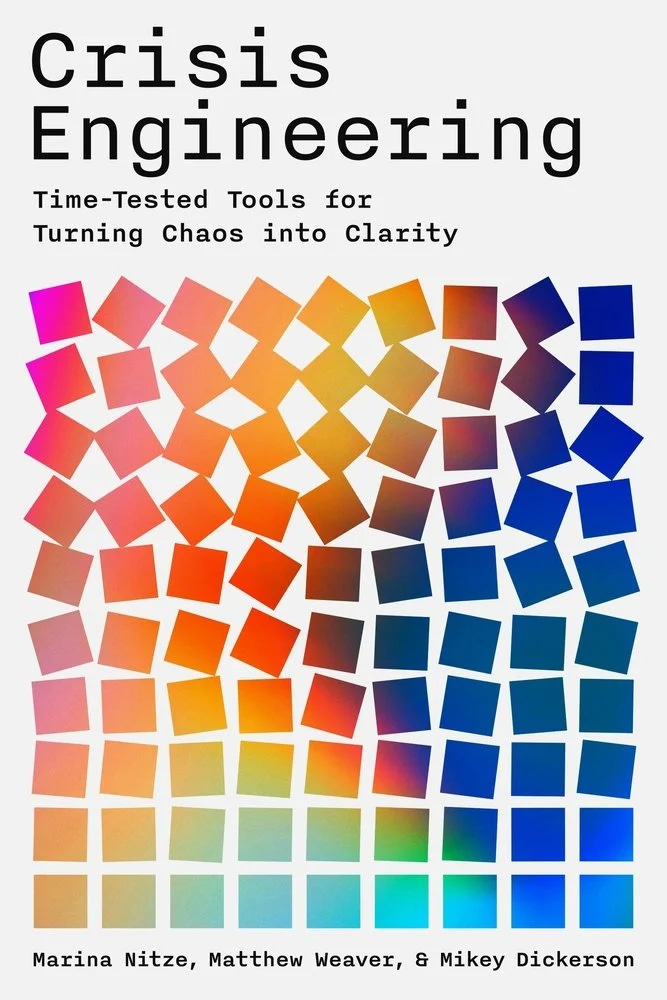
I love that Marina Nitze, Matthew Weaver, and Mikey Dickerson chose this story as a framing device for their new book, Crisis Engineering: Time-Tested Tools for Turning Chaos Into Clarity, out today. Not just because it brought back the memory of a book that I once loved, but because Maclean’s obsessive investigation of what had happened back then (he wrote the book years after the incident) seemed to me almost as heroic as the bravery of the smokejumpers. And indeed, his insistence on making sense of what happened has probably saved lives. Escape fires are now formally recognized and taught as a last resort tactic when training new firefighters.
The Dodge escape fire wouldn’t seem to have much to do with Three Mile Island or healthcare.gov or the pandemic unemployment insurance backlogs, but the authors use it to make a point about how action and understanding interact in a crisis. One key is exactly what Maclean himself did so well: sensemaking. In a crisis like Mann Gulch, sensemaking disintegrates: a broken radio, wind so strong communication is impossible, fire whose behavior violates well-tested assumptions, and a team scattered. You don’t achieve sensemaking by staring at a map; you achieve it by acting and observing results. Wag Dodge didn’t understand fire behavior well enough to explain the escape fire in advance. But his actions created the understanding itself — retrospectively, as all real sensemaking is.
The book’s key claim is that crises are opportunities, and the authors leverage Daniel Kahneman’s Thinking, Fast and Slow to explain why crises are the only real windows for organizational change — and why everything else, the incentives, the logical arguments, the reorganizations, mostly doesn’t work. Most organizations, most of the time, run on autopilot. People habituate to their environment, rationalize away small surprises, and build stable stories about how things work. A crisis breaks this. When surprise accumulates faster than the brain’s “surprise-removing machinery” can rationalize it away, the whole apparatus jams, and organizations become, briefly, reprogrammable.
An institution resolves a crisis in one of three ways, according to the authors. It makes durable deliberate change, it dies, or, most commonly, it rationalizes the failure into an accepted new normal. “Most large organizations contain programs and departments that passively accept abject failure: infinitely long backlogs, hospitals that kill patients, devastating school closures that do little to affect a pandemic. These are fossils of past crises where the organization failed to adapt.”
Too many of our public institutions have failed to adapt, and the idea that they might be reprogrammable at all is a bit radical. We live in an era when too many people have given up on them, willing to burn them to the ground rather than renovate them. If crises represent the chance for true transformation, then we’d better get a lot better at using them for that. This is explicitly why Crisis Engineering exists, and it’s a detailed, practical book — the theory and framing devices are well used, but there’s a ton of pragmatic substance here you’ll be grateful for when the moment comes.
I remember when I was working in the White House and frustrated by the slow pace of progress. My UK mentor Mike Bracken told me: Hold on, you just need a crisis. You Americans only ever change in crisis. Boom. About two months later, healthcare.gov had its inauspicious start. And he was right. Change followed. Not all the change we needed, but a start. Marina, Weaver, and Mikey are three of the people who drove that change. I got to work with them again the first summer of the pandemic on California’s unemployment insurance claims backlog. I’m not a crisis engineer, but their strategies and tactics have deeply influenced how I think about the work I do and how I think we’re going to get from the institutions we have today to the ones we need.
We may be living in an era when too many people have given up on institutions, but we are also likely entering an era of crisis, and even polycrisis. This makes for uncomfortable math, but also drives home the need for a new generation of crisis engineers.
When I first read about Mann Gulch, so many years ago, I remember being in awe of the ingenuity and courage it took to start Wag Dodge’s escape fire. Today I think a lot about that pattern: the controlled burns that reduce the risk of megafires, the little earthquakes that take the pressure off faults under great tension, the managed crises that, if we’re skilled enough to use them, keep our institutions from the kind of collapse that comes when nothing has been allowed to give for too long. Dodge didn’t burn things down. He burned a path through. We’re going to have to get good at that.
In my aerospace job, I frequently told my team, "never waste a good crisis."
Crises were the best opportunities to get the NASA bureaucrats (or company bureaucrats) to suspend or bend the rules. We could turn their inherent conservatism and fear of something going wrong on their watch back on them. Instead of them worrying about following the regulations, they were worried about getting the blame if we couldn't fix the crisis.
Of course, we then did have to fix the crisis, but that was the fun part.
Re Young Men and Fire - you might like Karl Weick's "The Collapse of Sensemaking in Organizations" which was based on the book.
https://www.cs.unibo.it/~ruffino/Letture%20TDPC/K.%20Weick%20-%20The%20collapse%20of%20sensemaking.pdf