

Today I'm excited to have Alex Mechanick here, making the case for the new permitting bill and why it should be a taste of what's to come as we tackle the procedures that hold government back. Alex is an assistant professor at the Johns Hopkins University School of Government and Policy (where I am also a senior fellow) and a senior fellow at the Niskanen Center.
On September 30, a bipartisan group of senators released an important 417-page permitting bill. Much of the coverage has focused on the implications of the bill for energy transmission buildout, or the ways that it will help specific forms of energy production, like geothermal. Expert analyses have estimated that it will make energy cheaper and reduce greenhouse gas emissions. All of that work is important. But, in my view, the Bipartisan American Affordability and Jobs Act (BAAJA)—is first and foremost a state capacity bill.
While BAAJA may have been born of an interest in energy generation and transmission, it is not just an energy bill. If it was, it would be weird that the American Public Transportation Association and the National Association of Home Builders endorsed the bill!
Chiefly, BAAJA is focused on getting rid of constraints on the government that stop projects from getting built whether the project is good or bad. It is about making government work. Any member of Congress who wants the government to be more effective should vote to pass this bill.
What is Permitting? And Why Is It a State Capacity Problem?
People use “permitting” to refer to all sorts of government actions that need to take place before something gets built. Think about the analyses, public input processes, or other steps that a project has to jump through before it can be approved; all these and sometimes more are sometimes referred to as “permitting.”
Today, the permitting process is a mess. And it touches not only almost everything that we build, but indeed every change that we seek to make in the physical world. Since approving high-speed rail in 2008, California has spent billions upon billions and still has nothing to show for it because, in part, it has gotten stuck in permitting processes. Offshore wind farms are stalled for more than a decade by lawsuits alleging trivial violations of procedural statutes. It’s not just building: long permitting processes mean prescribed burns of forests get delayed for so long that wildfires grow more frequent and more damaging.
Contrary to the views of some, the permitting problem is not primarily a result of climate, health or safety regulations. While statutes like the Clean Air Act, the Safe Drinking Water Act, or the Occupational Health and Safety Act could be improved, the evidence of their effectiveness is strong. Their successes are a testament to the government’s ability to solve big problems.
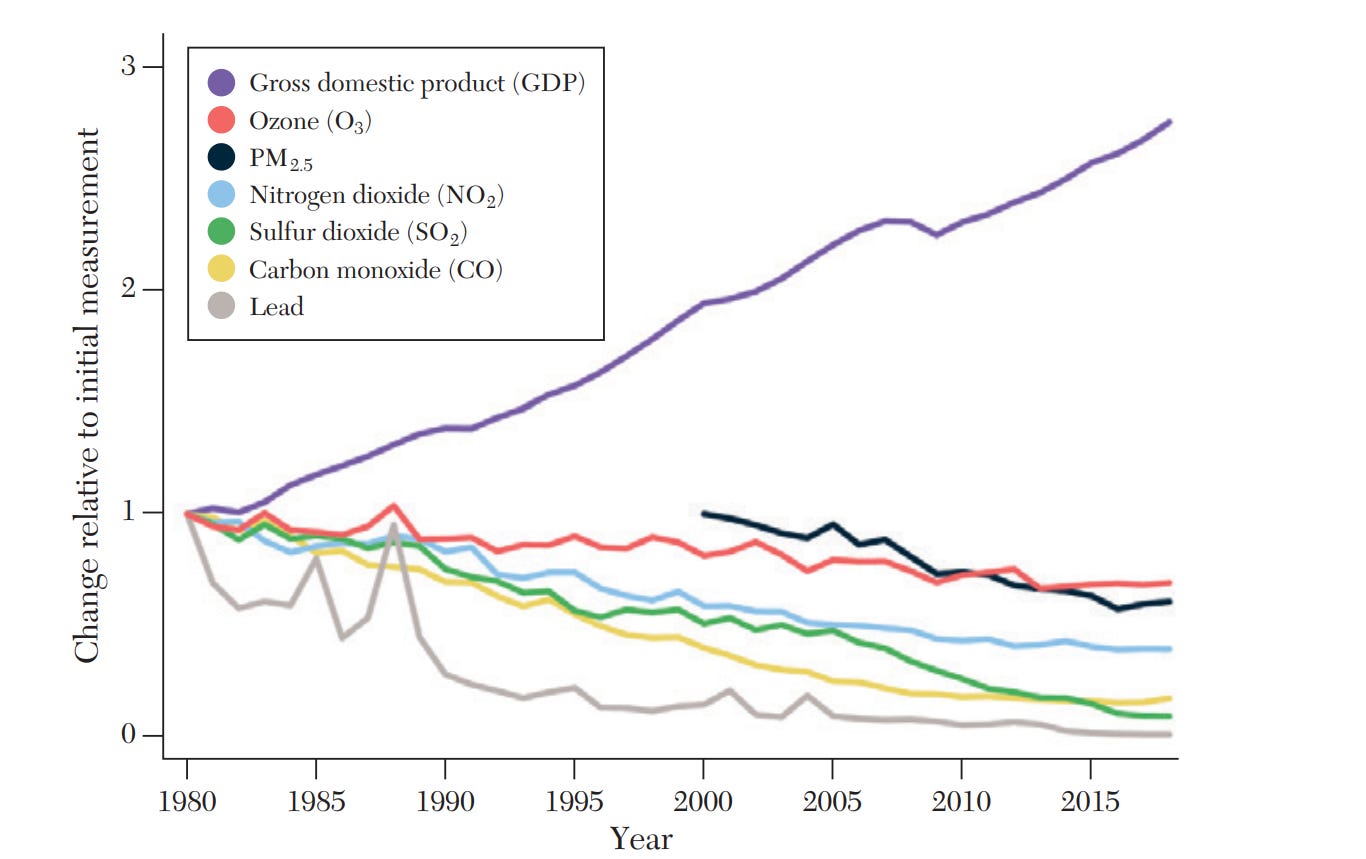
No, the core obstacle to building, or making other important improvements to the physical world, is not substantive regulations but rather our broken permitting procedures. The evidence is everywhere: These procedural laws led the cost of interstate highway construction to spike. Building new highway lanes (which trigger these procedures) has gotten much more expensive, while repaving highway lanes (exempt from them) has not. Permitting caused the productivity of the entire U.S. construction sector to not only stop improving around 1970, but to start going backwards. Think about this: had construction productivity grown by 1% per year instead of falling by 1% per year (a fairly modest growth rate!) average income per person in the United States would be 10% higher today. Permitting procedures are broken, and they are breaking far more than our energy sector.
Permitting Problems Are State Capacity Problems
How can procedural laws that so few have heard of, like the National Environmental Policy Act (NEPA) and the National Historical Preservation Act (NHPA), cause so many problems? All that they do is force agencies to conduct a detailed analysis of the effects that a project may have on the environment, or historic areas. If a judge finds that an agency failed to do a detailed enough study, they void any permits and order the agency to do it again.
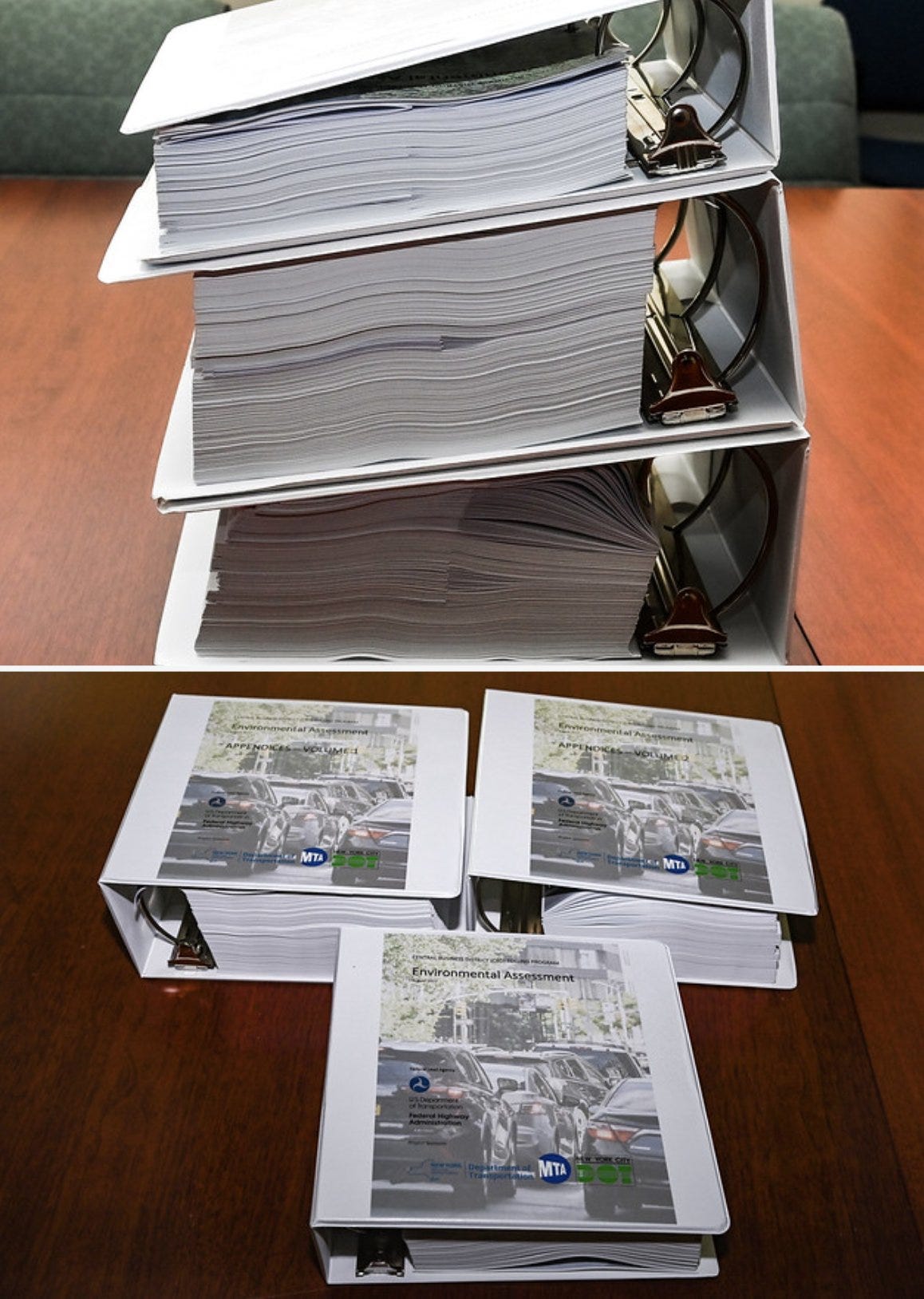
But that simplicity is deceptive: how much detail is enough detail? It is especially difficult because long before NEPA and NHPA were passed in the late 1960s, the Administrative Procedure Act of 1946 already required that agencies not act in an arbitrary or capricious manner. Surely NEPA and NHPA mean something more! But with “more” comes creep, and risk-averse agencies rationally spend ever-more time and more effort to ward off challenges that take a project back to square one. Page counts of environmental impact statements under NEPA have ballooned from 414 pages in 1977-78 to 1,703 pages in 2013-17. And the time it takes to complete them has grown longer and longer:
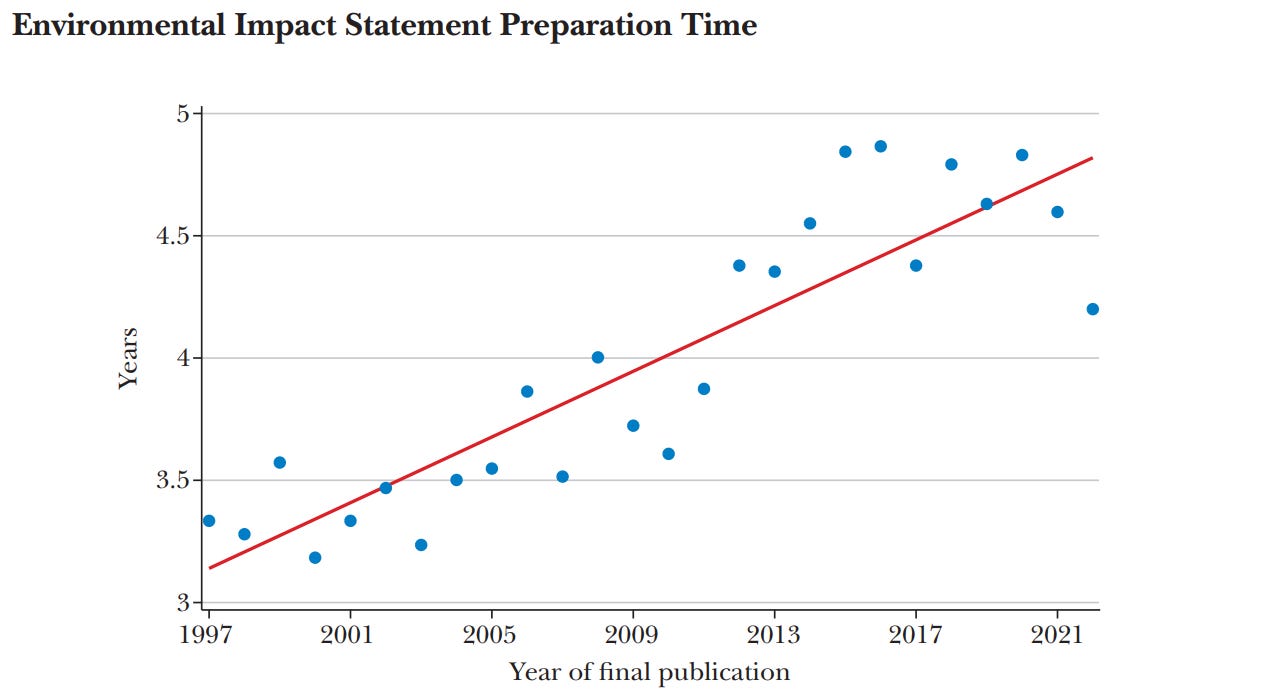
The result is decisions that are too slow and too costly, both for private projects and for projects done by the federal government itself.
And yet, these costly procedures do little to constrain agency decisionmaking. For example, NEPA and NHPA have done essentially nothing to thwart presidential abuses of power. That work is primarily done by the Administrative Procedure Act, which prohibits unlawful and unreasonable agency action. Worse still, NEPA and NHPA do not even mandate that agencies actually do anything to protect the environment, or historical areas. That is what substantive statutes do (like the Clean Air Act for air quality). At best, NEPA and NHPA force the production of a little more information that could indirectly feed into a determination that those substantive statutes were violated. The limited and attenuated benefits of these procedures are not worth their massive costs.
The solution to a government that makes mistakes is not a government incapable of succeeding. We can do better.
How BAAJA Fixes A Huge State Capacity Problem
BAAJA is a huge bill, and it makes many changes to permitting processes. But the most important way that BAAJA cuts through the morass is by changing what happens when an agency violates only NEPA or NHPA alone. (That is, when the agency does not violate a substantive regulatory statute, the Administrative Procedure Act, or any other law.) Instead of voiding the permits and sending everything back to square one, the project continues as the analysis is fixed.
BAAJA does not touch the Administrative Procedure’s protections that prevent abuse. If an agency violates a regulatory standard, or acts arbitrarily or capriciously, any harmed party can still challenge the action, and stop the agency. But by defanging the worst consequences of procedural permitting litigation, BAAJA ensures that the federal government can make reasonable decisions and help them stick.
That means that it is not just energy generation and energy transmission projects that will be sped up (and made cheaper) by BAAJA. It’s transportation projects like rail, congestion pricing, and port deepening. It’s projects that will expand water reservoirs, restore lakes, and thin forests to prevent wildfires. It’s even federal housing projects, presidential libraries, and broadband buildout.
No more stopping everything while litigants play whack-a-mole over how detailed the analysis needed to be. No more taking years to develop thousands of pages of analysis in an attempt to bullet-proof it. Agencies can get the input they need, and do the analysis that they need, to make a decision that is reasonable, and have confidence that will be enough.
There Is More Work to Do, But BAAJA Is a Great Start
Much like when NEPA gets in the way of prescribed burns, analyses that focus too much on BAAJA as an energy bill miss the forest for the trees. Under BAAJA, the federal government can study a problem, write down an analysis, make its decision, and (so long as that decision was lawful and reasonable) move forward with getting things done. That gives confidence to private developers that they can build things, whether they be new technologies like long-duration heat batteries on federal land or the buildout of 5G cell phone towers. And that gives governments confidence that they can implement actions that are clearly good for the environment, like congestion pricing, without years of unnecessary delay. BAAJA creates a government that is more effective, without leaving it free to abuse its powers.
There are, no doubt, more procedural fixes to make beyond BAAJA to create a government that is more effective and more constrained. Passing BAAJA lays necessary groundwork to tackle those future challenges.
For example, beyond BAAJA’s approach to energy transmission (and previous legislation that addressed natural gas pipelines and cell phone towers), more needs to be done to curb state and local governments’ ability to block urgent national priorities from getting built without good reason. Laws structured like NEPA and NHPA, but that only apply to federal agency rulemaking, should be addressed as well. Statutes like the Small Business Regulatory Enforcement Fairness Act and so-called “hybrid” rulemaking requirements impose a similar time tax on agencies as permitting procedures, and similarly come with almost no benefits. And the Administrative Procedure Act itself could be improved, leaving more room for judges to forgive agencies’ harmless errors, making sure that litigants cannot “judge shop” to ensure that the most extreme judge that they can find rules on cases that affect the whole country, and cutting down on presidential abuses of power. There is plenty more to say about all of that.
But all of those future reforms will become easier with BAAJA on the books. It will be easier to address the fifth of the country subject to state and local prohibitions on building solar or wind energy projects if state efforts to block energy transmission have already been addressed in BAAJA. It will be easier to fix rulemaking procedures that operate like NEPA and NHPA after BAAJA has addressed the problems of NEPA and NHPA. And reforming the Administrative Procedure Act becomes far more possible when doing so is disentangled from fights over permitting.
BAAJA is a huge bill, and it changes many other aspects of the permitting process. Much could be written on its changes to the public engagement aspects of NEPA and NHPA, section 401 of the Clean Water Act, speeding and improving judicial review, and so-called “permitting certainty.” Indeed, I have another (longer) piece that touches on all of those topics.
When Congress comes back into session for the lame duck, it will have an opportunity to pass this permitting bill. (Or more likely, an amended version that hopefully makes some technical corrections to the first draft.) Fans of effective government should see that for what it is: a make-or-break opportunity for building energy projects, yes. But also a make-or-break moment for building state capacity.
