

It’s been quiet here. Sorry. I don’t have writer’s block — I just can’t seem to actually finish any of the 30 or so blog posts I’ve started. I promise to actually publish some of them soon. In the meantime, there’s a lot of great stuff out there. So let’s do a round up of state capacity content you should read! I may even make this a regular thing.
Move Fast. Fix Things.
A speech by Darren Jones, Chief Secretary to the Prime Minister, UK Cabinet Office — Jan. 20, 2026
Like my collaborator Andrew Greenway’s recent screed (and where I found this), this is worth reading from across the Atlantic. Darren Jones, the UK’s Chief Secretary to the Prime Minister, gave this speech in January laying out a plan to rewire Whitehall — and the diagnosis will feel familiar. Years of bureaucratic layering have produced a civil service that spends more time checking than doing, more time on internal policy papers than on delivering services to citizens. Jones’s proposed remedies are concrete: a new framework rolling out in April that cuts approval processes (one HMRC pilot reduced 40 required approvals to 2, saving two to three months of delivery time), new hiring criteria for senior civil servants that weight frontline delivery experience over policy-writing ability, and performance management with actual teeth. The title — a deliberate riff on Silicon Valley’s “move fast and break things” — makes the point that speed and care aren’t opposites. The UK hasn’t necessarily figured this out any more than we have, but they are naming the same problems out loud and commiting to specific structural changes.
A question for the comments: If the equivalent of this speech were given in the US, who would give it?
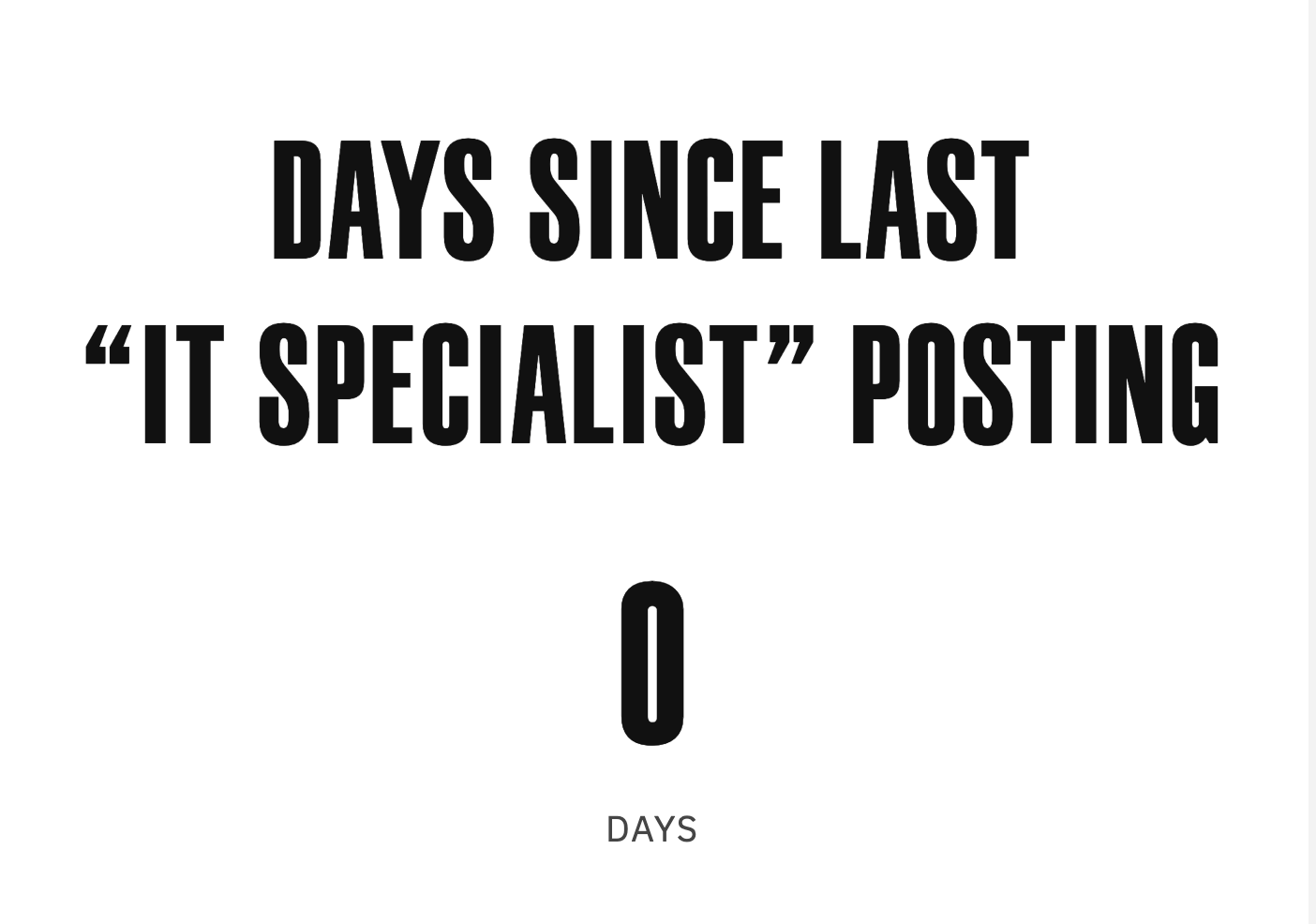
Plain Job Titles Please
State Capacitance / Kevin Hawickhorst, Foundation for American Innovation — Feb. 5, 2026
My favorite gimmick of the year so far is Kevin Hawickhorst’s Days Since Last ‘IT Specialist’ Posting tracker.
If you want to scare qualified software engineers off of applying for your open role (or ensure they never see it), make sure you call the position an “IT Specialist.” You can post design, user research, and product management roles as IT Specialists too. (While you’re at it, call practically everything else a “Program Analyst.”) It’s a fantastic way to make some of the most meaningful and important jobs in the country sound like an opportunity to change the toner cartridge in bleak offices around the federal government.
IT Specialist comes from an OPM publication issued in May 2001 (that’s 25 years ago, but who’s counting) entitled “Job Family Standard for Administrative Work in the Information Technology Group, 2200” which establishes the authorized official position titles for IT Management. It was the standard job title until September 2025, when the Office of Personnel Management (OPM) issued guidance in response to Executive Order 14170 instructing agencies to stop using “generic or jargon-laden” job titles and to replace them with titles that are “descriptive, organizational, or functional in nature.” Many have. But as the Foundation for American Innovation’s tracker shows, some agencies are finding it hard to move on.
FWIW, New York has it worse. Their tech jobs are all called “Computer Associates.”
When FAFSA Broke, They Called This Guy
Statecraft / Santi Ruiz — 2026
Jeremy Singer, President of the College Board, spent six months inside the Department of Education helping rescue the botched FAFSA rollout. Santi does his usual expert job of drawing out the story. The chaos was caused by a convergence of the familiar culprits: legislative drafting that was precise in intent but catastrophic in execution, political leadership with its eye on a different prize (loan forgiveness), and the by-now-ritual inability to communicate honestly with the public when things go wrong. Listen in particular for Singer’s observation about why the lessons of healthcare.gov didn’t seem to make their way to the Department of Education, or throughout Democratic leadership.
One Neat Trick for Buying Software That Isn’t Trash
StateScoop / Waldo Jaquith — Feb. 2026
Spoiler alert: the trick is just hiring people who actually understand software. Waldo Jaquith — government delivery manager at U.S. Digital Response and a veteran of this fight — makes the deceptively simple argument that agencies can’t buy good technology if they don’t employ people who understand it. Without that internal expertise, you can’t write a sensible RFP, you can’t evaluate vendors, and you end up getting precisely what you asked for — which is to say, trash. The logic is the same one we’ve been making about state capacity for years: you can’t outsource your way to competence. Given that we just watched the federal government shed hundreds of its most capable technologists, this argument feels newly urgent.
What Breaks Us
Bryce Fountain, LinkedIn — 2026
Saw this randomly on LinkedIn. Bryce Fountain served eight years in the Air Force. He’s done. And the thing that broke him wasn’t the deployments or the danger — it was six months waiting to be reimbursed $5,000 in legitimate expenses because the Defense Travel System, which apparently runs on logic from the 1990s, couldn’t process a trip that got changed and then canceled early. Meanwhile, a contractor traveling alongside him emailed receipts to HR and had money in his account the next day. It’s easy to talk about “procurement reform” and “legacy IT modernization” in the abstract and lose sight of what bad government software actually costs — not just in dollars, but in the people who walk away because they’re done being treated, as Bryce puts it, “like second-class citizens.” A lot of very smart people have tried to fix the DTS. Someone tell me in the comments why we’re still stuck here.
Blue Cities and States Are in Trouble. Democrats Need to Change How They Run Them.
New York Times Opinion / Nicholas Bagley & Robert Gordon — Feb. 23, 2026
The authors of this op-ed are both veterans of Democratic administrations, and both colleagues of mine — Robert is at Recoding America (though he is writing in his personal capacity here) and Nick and I are both senior fellows at the Niskanen Center. They are saying something Democrats don’t often say out loud: the party’s relationship with public sector unions is making it harder to govern, and something has to give. Their argument isn’t anti-union in any simple sense; it’s that the current arrangement lets unions prioritize the interests of their existing members over the quality of services that the public — and especially lower-income communities — depend on. They’re calling for a new bargain: one that protects workers’ voices and livelihoods but puts public services first. The piece may be uncomfortable for some, but it’s pointing at a structural problem that’s been quietly obvious to anyone who’s tried to reform a public system from the inside.
Is a New Teacher Better Off in Mississippi Than in New York?
Slow Boring / Matthew Yglesias — March 5, 2026
Almost a companion to the Bagley/Gordon piece, Yglesias starts from a fact that should alarm anyone who cares about public investment: we are living through a surge in anti-tax politics, and it’s not just coming from the right. Across the political spectrum, people are losing faith in the proposition that paying more taxes produces better outcomes they can actually see in their lives. Teacher compensation is his case study. New York spends vastly more per pupil than Mississippi or Louisiana — and is getting roughly comparable outcomes. Mississippi and Louisiana, meanwhile, have been posting some of the biggest educational gains in the country, largely through curriculum reform that costs relatively little. So are high spending and good outcomes as correlated as the left would like to believe? Yglesias’s argument is that if progressives want to make the case for public investment — in schools, in services, in anything — they first have to be able to show that existing money is being well spent. Meanwhile, in California, newcomer to the governor’s race Matt Mahan seems to be the only candidate recognizing this.
I’ll probably be saying this a lot this year: capacity isn’t the number of people or the size of the budget, it’s the demonstrated ability to achieve policy goals.
Bureaucracy As Social Hope: An Argument for Renewing the Administrative State
Federation of American Scientists / Hannah Safford, Loren DeJonge Schulman, Craig Segall, and others — Feb. 12, 2026
FAS just launched a new Center for Regulatory Ingenuity, and this essay collection is its opening argument. It starts from the observation that every major political faction has arrived at the same conclusion — that the administrative state doesn’t work — but they’re telling very different stories about why, and proposing wildly different remedies. The authors’ counter is that the government we have was largely designed to move slowly and deliberatively, to resist capture by any particular interest. That design produced real successes. The problem is that the tools that got us here aren’t the tools that will get us to where we need to go — and we are now, as they put it, “starting to hit real limits.”
The collection uses climate policy as its lens, but the insights travel well. The essays, which will be published over the course of the coming weeks, range from Jordan Diamond and the Environmental Law Institute on the limits of 1970s pollution statutes for driving a 21st-century energy transition (out now), to Loren DeJonge Schulman and Shaibya Dalal on public participation as a governance asset rather than a compliance burden. Hannah Safford and I are working on our contribution to this series, on a critique of government’s obsession with planning, or rather, the tendency of government to treat the plan as the destination rather than the compass. (Eisenhower said it well: “In preparing for battle I have always found that plans are useless, but planning is indispensable.”) The collection’s conclusion is bracing: “taking a chainsaw to government leaves our whole nation bleeding” — but neither is defending the status quo a plan.
A Premortem on OPM’s HR 2.0 Initiative
Niskanen Center / Steve Krauss, Gabe Menchaca, Peter Bonner — March 2026
Rather than waiting for the inevitable GAO report or congressional hearing that will someday explain why the federal government’s effort to consolidate its sprawling HR systems fell short, the authors — all former senior officials at OPM and OMB — have done a premortem: imagining failure now, in order to avoid it. The underlying problem is real: the federal government runs dozens of incompatible HR systems, hundreds of interfaces, and countless manual workarounds that are costly, brittle, and increasingly unable to support how government actually needs to recruit and manage people. The Trump administration’s HR 2.0 initiative aims to fix this. Maybe it will! But the authors want to make sure we go in clear-eyed about how these things tend to go wrong.
The Melting Pod: Biden and the Border
I’ve just started this brand new podcast from alums of the Biden admin, so caveats apply, but it asks a question that always fascinates me: How can many caring, smart, well-meaning people thoroughly bonk something? I’ve been warned there’s no facile answer here, which generally checks out, and I appreciate the honest tone of the pod so far. I’ll be listening for state capacity lessons that might apply under any administration.
That’s it for the first roundup. If you like it, maybe I’ll make it a habit!
"A question for the comments: If the equivalent of this speech were given in the US, who would give it?"
Did you see recent The Free Press piece on Joe Gebbia, co-founder of AirBnB, who is actually doing good work redesigning government websites and other user-interface problems?
https://www.thefp.com/p/joe-gebbia-is-making-the-government
In quiet contrast to Musk's DOGE belly flop, Gebbia figured out that he needed to appeal to Trump's appreciation of "hospitality" aesthetics and has been given free reign to fix (and make more pleasing) the experience of interacting with government. In many ways, he is your counterpart in this administration.
Jennifer, Bryce Fountain's DTS story landed hard for me.
I spent two decades in the Air Force. That system was already grinding people down when I left. The contractor beside him got reimbursed the next day because someone owned his problem. Nobody owned Bryce's.
That is a product failure. A real user. A broken experience. A system nobody is stewarding past the contract signature.
I now work with the State of Pennsylvania. The same pattern shows up at the state level. Vendors deliver. Contracts close. Users inherit whatever got built. The agency moves on. Nobody stays accountable for outcomes.
Waldo Jaquith's point about internal competence is exactly right. You need someone inside who owns the problem after the work is done. That person has to exist before the RFP goes out, not after the audit.
The job title tracker made me laugh, then wince. A title tells you what an organization believes the job is. "IT Specialist" says maintenance. It says keep-the-lights-on. It does not say user advocate. It does not say problem owner.
Your line about capacity being "the demonstrated ability to achieve policy goals" is going on my whiteboard. That is the clearest definition I have seen.