

Many of you know of Marina Nitze, co-author of Crisis Engineering and Hack Your Bureaucracy. Marina is a crisis engineer at Layer Aleph and a Senior Fellow at Tech Viaduct. She founded the Child Welfare Playbook and is the former Chief Technology Officer of the U.S. Department of Veterans Affairs. Yes, this the same Marina Nitze who figures out how to clear California’s unemployment insurance backlog in Recoding America. As you’ll see below, she’s been figured some more stuff out.
This is long, but I promise you its well worth it, certainly for the practical solution she gets to, but even more for what her journey to the solution teaches us. This is a leap forward. You’re just going to need a little time to digest it.
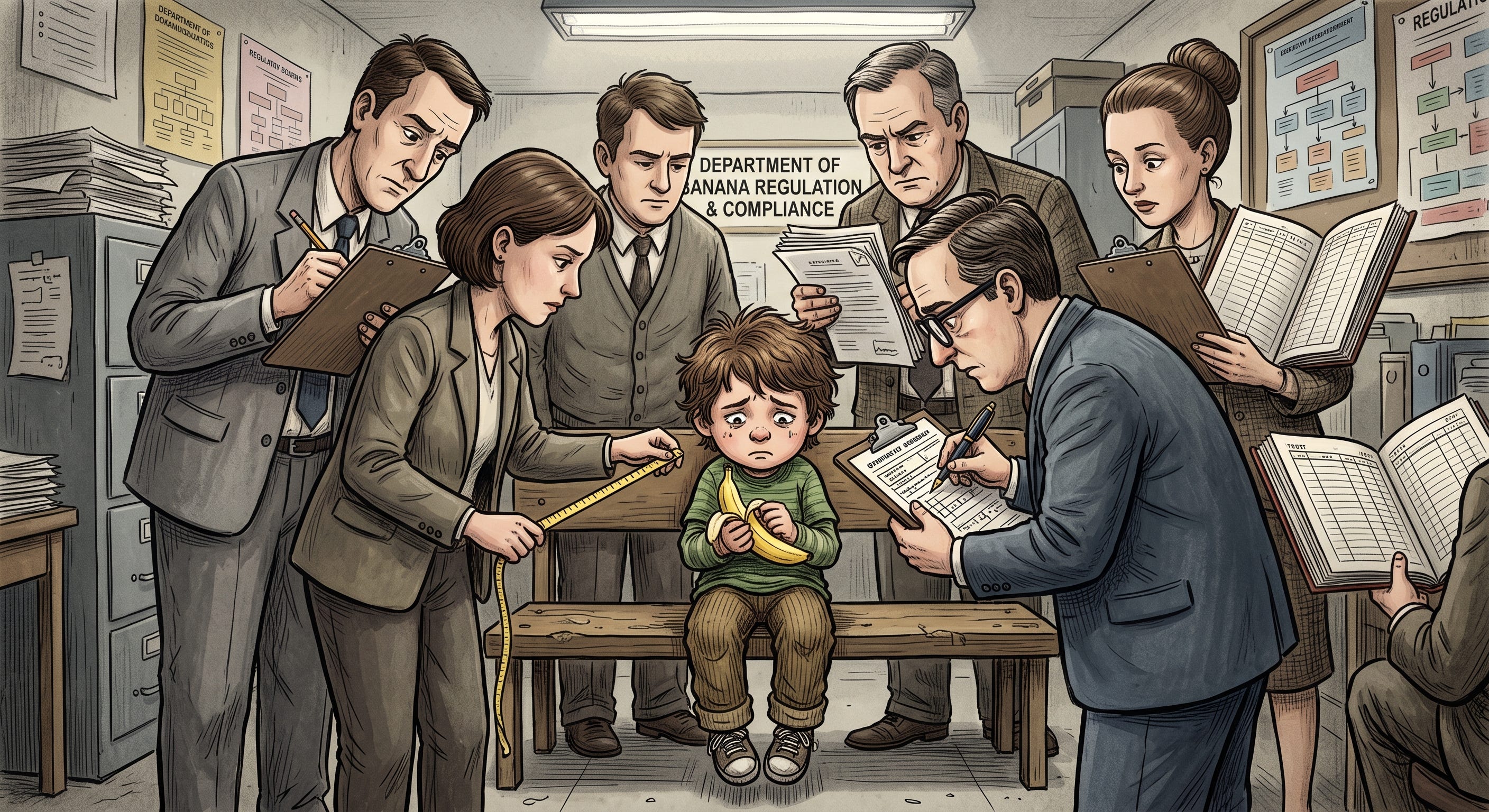
Jen wrote a piece about how daycare workers can’t peel bananas, which boils down to a rule about sinks: rules govern where food may be prepared; somewhere down the line peeling a banana came to count as preparing food, which would require a dedicated sink; and so daycares had no choice but to swap fresh fruit for packaged crackers.
Some readers looked up the actual regulation, which of course does not say “thou shalt not peel bananas,” and blamed the childcare workers for overreacting. Just peel the bananas — what’s the big deal? On the other end, Congress took up the case with the Cutting Red Tape on Child Care Providers Act, which would carve out a category of low-risk foods daycares can serve without triggering the kitchen sink rules. In other words, Congress is spending time amending federal law to address peeling bananas.
Both these takes are totally wrong.
I know, because I spent years on the foster care version of peeling the banana, and made both mistakes myself—repeatedly—until we figured out the answer.
In Jen’s three horizons for government reform framework, Horizon 1 is the system we have, Horizon 3 is the one we need, and work in between either keeps the old system alive by relieving the pressure on it (Horizon 2-) or builds the conditions for the world we want (Horizon 2+).
Most of my time in foster care was inadvertently Horizon 2-. I thought the mission was: find the sink rule, fix the sink rule, eat bananas! Every rule we fixed made one state’s foster care system work a little better… but left the machine that produced the rules untouched.
That machine has a name: the cascade of rigidity. Each layer of government interprets the layer above it a little more stringently than the one before, because nobody has ever been blamed for being too careful. Rules only ever get added and calcified, never taken out or relaxed.
This is a happy story about turning the cascade of rigidity on its head. The story ends with lots more foster kids safely in the arms of their loving relatives.
But the story starts with a box of index cards.
A Box of Blueberries
In 2017 I had just left my job as Chief Technology Officer of the U.S. Department of Veterans Affairs, where I led successful efforts to improve Veterans’ experience of the VA. My former boss Richard Culatta, who was by then the Chief Innovation Officer of Rhode Island, mentioned their foster care system had some challenges (whose doesn’t?). As I was figuring out what to do next with my life, perhaps I could come take a look?
I flew to Providence. Upon learning I was a technologist, they rolled out the latest plan they were working on: hire Palantir to use “big data” to better match children to foster homes.
Except … here is an actual snapshot of the database of foster homes at that time:
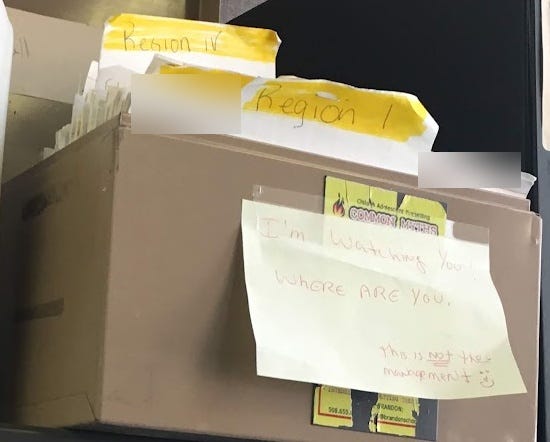
Whatever your feelings about Palantir, they were not going to derive many insights from this box. All you had to do was look at it to understand they didn’t have enough licensed foster homes to place every child anywhere, let alone to make data-driven matches.
One thing I learned from my time at the VA was to talk to your users before you do much of anything else. So I asked a local foster parent support group if they’d introduce me to some families who had dropped out of becoming foster parents, figuring they’d have the juiciest insights to share. I bought them coffee, and they all told me the same story: they were excited to foster. They signed up. But then they’d call to ask how many training hours they had left, or whether the office had gotten their cat Blueberry’s vaccination records (pet vaccinations were a licensing requirement), and whoever answered the phone did not know, and didn’t call them back. “If this is how you treat me when you’re recruiting me,” they confided, “how are you going to support me when there’s a child in crisis in my living room? I’m out.”
Over 80% of families who started the process in Rhode Island were dropping out before they ever fostered a child. That math sounded bad in such a small geographic area.
Meanwhile, the licensing staff, who were absolutely lovely and heroic and completely underwater, were spending their afternoons on the floor trying to match all of the various documents that arrived unmarked — medical forms, character references, and yes, Blueberry the cat’s vaccination records — to the correct family.
While I was happy to dig through file cabinets with them—and did!—I felt like I could be more helpful by making a spreadsheet on their SharePoint (the only agency-approved tool at the time) to keep track of all the prospective families. Now when a family called, whoever answered could easily find their records and answer their questions.
With all the pending work now quantified, the team had the brilliant idea to follow up with a “finish-up weekend” with fingerprinting, physicals, and training classes all available to prospective foster parents to complete licensure. 174 families completed their licenses in two days. Dropout rates plummeted.
Great! Without so many dropping out, surely we’d have enough foster parents now. But it turns out that was not the root of the problem.
The First Banana
I started to dig into the specific licensing requirements for becoming a foster home that we were tracking on that spreadsheet. Rhode Island explained to me that federal law required the fire department to come to your house to confirm you had a fire extinguisher. If you didn’t have one, you had to wait a month or more for the fire chief to come back and confirm you’d bought one. (In an unexpected twist, Ashton Kutcher highlighted this story on Dax Shepard’s podcast in 2020.) Of course, my first reaction was: we should fix that law!
Around the same time, my new crisis engineering company, Layer Aleph, got hired to look at California’s child welfare system, which was in distress. In the course of that engagement I noticed something odd: California was sending no fire chiefs to no houses. Wasn’t that law? California also had a category of foster homes Rhode Island didn’t (“non-relative extended family members”, memorably referred to as “nerf-ums”), and Rhode Island had waivers California didn’t. How could they be so different?
I got officials from the two states on a Zoom and had them explain to each other, in detail, how they were legally doing the things the other one thought were illegal. It turns out there were no federal laws forcing fire chief inspections or preventing waivers. Rhode Island could skip the fire chief inspections, and California could have waivers.
A-ha! That must be the solution, then. Show one state that another state is allowed to do something, and then they can both peel bananas.
A Bushel of Bananas
I started a regular meeting between California and Rhode Island to dig in further. I also cold emailed my home state of Washington to invite them to my new “working group.” Ernest Blackwell from Washington State’s Department of Children, Youth, and Families (DCYF) dutifully showed up. (Rest in peace, Ernest.) Every month we picked one specific topic. I spent an hour with each state asking how their version of that process worked, then brought everyone together to compare notes. Other states heard about our meeting and started showing up, too.
The group dug into truly tiny things that had somehow become big blockers. Indiana mentioned offhand they thought it was weird that foster parents had to be fingerprinted twice — as in, put their fingers down on the pad, pick their hand up, then put them back down a second time. (This also meant Indiana was paying twice.) Washington heard this and said, “Oh! You filled out the state form wrong. That first print is for foster care, and the second is for adoption. If you use Purpose Code X, you only have to fingerprint them once.” Indiana (and a few other states that were also listening) immediately made this change.
Though I had come upon it accidentally, licensing – the process by which individuals are formally authorized to care for foster children – seemed like an ideal “Trojan Horse” for changing foster care. It was, in most states, still done on paper. It had never been the focus of a modernization plan, or the headline of a budget request or a newspaper. Digitizing forms and removing duplicative fingerprints was a quiet, non-controversial way to get to know the technology systems, update policies, and meet decision makers in multiple states.
That working group is now in its ninth year and includes every state. For the first few years, a state fixed one thing, told the others, and a few of them followed suit. Every month I could point to a rule that had gotten better somewhere. I thought we were making progress.
Now, surely, if one state would let me redesign their entire licensing process from end to end, using all the insights from the group, that would peel all the bananas… right?
Washington State’s Weird Obsession with Recycling
In 2020, Washington DCYF stood up a series of taskforces to rewrite its foster licensing rules. I volunteered to “take notes,” which may have led to my asking many annoying questions and piping up with many unsolicited suggestions. This was my biggest swing at fixing one state from the inside—and it’s where I first heard about the recycling bins.
Washington State had a rule that you could not get licensed as a foster parent if you didn’t recycle. One of the taskforce licensors shared that she had never been able to license a family living on tribal land, because they had no recycling service. Nobody could explain what recycling had to do with a child being safe, or why it was in state code. How weird.
The taskforces surfaced more mysteries. You couldn’t get licensed if your hot water heater exceeded 120°F, a setting you can’t necessarily control if you live in an apartment building. Your dog needed a current pet registration, because nothing says safety like whether you paid $10 to the county for a tag. At least one applicant in the home had to have “functional literacy,” a phrase nobody in the room could define. One licensing worker, crying, told me she had just told a grandmother to choose between her grandson and euthanizing her elderly dog, who was too sick to get a required vaccination. She insisted, through her tears, that she had not become a social worker to kill dogs.
The reflex when you hear these rules is: obviously they didn’t mean that. But there is no “they.” By the time the requirement reaches the licensor, it’s in the state code, and on the required form. The licensor can’t not require it.
That’s the cascade of rigidity. Nobody along the way made a conscious bad decision. There is no mustachioed villain. Every person in it did the careful thing on any individual issue, and there’s no one whose job is to subtract or reconcile the whole. In the case of foster care, this led to a laundry list of individual requirements on everything from recycling to pet registration, while no one actually considered whether the list was in the best interests of placing children in safe and loving homes.
Dan Davies calls this an accountability sink. In The Unaccountability Machine he tells the story of 440 designer pet squirrels that arrived at Schiphol airport in Amsterdam in 1999 without the right permit. The airline didn’t know what to do, passing the dilemma on to the airport’s agricultural department, whose priority is biosecurity, not animal welfare. Their policy for animals without paperwork was euthanasia. The only equipment on hand was an industrial poultry shredder… so the squirrels all went into the shredder. The workers who shredded the squirrels didn’t have the authority to decide that a day-old chick counts and a squirrel doesn’t. That’s also the banana: the sink regulation is sensible, the licensor’s reading of it is sensible, the director’s decision not to risk her license over fruit is sensible… and in the end, kids don’t get fruit, and hundreds of squirrels get shredded.
I was determined to chart a different path in foster care. The taskforce volunteers did tons of real and impressive work: user research with caregivers and staff, redesigning every form, and entirely removing rules like the recycling bins. They even rewrote the state administrative code.
I came out of the taskforce with a list of problematic licensing requirements that we had mostly eliminated. Washington sure had a weird obsession with recycling and literacy, I thought, but we’d fixed it — right?
Turns Out, Everyone’s Obsessed with Recycling
I brought the list of eliminated requirements to the next working group meeting, mostly for the laughs. Recycle bins, amiright?
But Missouri didn’t laugh. Missouri’s own rules said “proper trash and recycling disposal, if recycling is available,” which is Washington’s exact sentence, down to the comma. Illinois shared that theirs said “proper trash disposal and recycling when available.” Delaware and Alabama pulled up their rules, which said “proper trash and recycling disposal” (with no qualifier). Kansas recently rewrote its regulations and added “trash and recycling disposal,” issuing a corresponding form waiving this requirement for relatives.
Six states independently arrived at nearly the exact same sentence about garbage. What??
Every state also had its own pile of esoteric requirements. Maryland banned bunk beds, while every other state purchased them. Several states had a minimum income requirement, which meant often Grandma didn’t make enough money to be given money to feed the kids. States required square footage per child, landline telephones, and fenced bodies of water.
I thought I could explain the piles: each state had accrued theirs over decades, one rule at a time, each added by someone being careful after a lawsuit or a news story. Still, I couldn’t explain the matching language. How do six states that don’t talk to each other all come up with “proper trash and recycling disposal”? Where was this coming from?
Six States, One Sentence
They constantly try to escape
From the darkness outside and within
By dreaming of systems so perfect
That no one will need to be good.
— The Rock, T.S. Eliot
The same sentence in six states can’t be a coincidence. So I went looking.
Federal law says surprisingly little about foster home licensing. The Social Security Act, the statute behind the federal foster care program, requires only that a state’s licensing standards be “reasonably in accord with recommended standards of national organizations.” It details nothing about these licensing standards besides requiring a specific background check.
The “reasonably in accord” phrase dates back to 1975 as part of Title XX, a social services block grant. When Congress created the federal foster care program in 1980, it didn’t write a new licensing standard, but rather made a one-line cross-reference to that Title XX clause. However, the 1981 budget reconciliation act block-granted Title XX and repealed the original clause, breaking the cross-reference. The same act patched the hole by copying the 1975 words directly into the foster care statute, where they’ve sat ever since.
For the next 33 years, the sentence pointed at nothing in particular. There were no national standards for foster family homes for a state to be in accord with. States wrote their own rules, usually after a lawsuit or a tragedy, and the fire chiefs and bunk bed bans accumulated one layer at a time.
In 2014, a coalition of national organizations published the first model. In preparation, they read every state’s licensing rules and found, in their words, standards “that had more to do with middle class ideals and the result of lawsuits.” This model was a great effort by good people who wanted more safe foster caregivers to get licensed.
It’s also where we find the sentence I was looking for: “Regularly dispose of trash and recycling.”
In the original model, every standard is accompanied by INTENT and GUIDELINE sections explaining what the rule is for and how to apply it thoughtfully. For example, “functional literacy” is listed as a standard. So is minimum income. But the model’s guidance says functional literacy does not have to be in English; the standard is reading and writing well enough to function in the community where you live, and if your community operates in another language, then English isn’t necessary. Under the income standard, it advises agencies to ask for verification only if a home visit turns up no food or no heat, and to augment with support when possible.
Thoughtful, nuanced, well-intentioned. Three things the cascade of rigidity sucks at.
In 2018, Congress told the U.S. Department of Health and Human Services (HHS) to identify “reputable model licensing standards.” In response, HHS published a version of the 2014 model without ever going back and talking to the people who wrote it. Economist Anthony Downs has a name for when a federal office drafts rules it will never have to apply: “superman planning,” which gets worse “the farther the officials formulating action alternatives are removed from direct responsibility for carrying out the actions they propose.” HHS is about as far from a kitchen table on a reservation as an office can get. The federal model kept the top-level standards but dropped the explanatory paragraphs. “Functional literacy” survived; the sentence explaining it needn’t be in English did not. The income requirement survived; the helpful qualifications did not.
HHS was explicitly asked to define terms like “functional literacy” and refused. Recycling came through as “proper trash and recycling disposal, if recycling is available.” Ta-da!
From there, the rigidity cascaded down into the states. Let’s look at what happened in Washington State. DCYF’s licensing division filled out a crosswalk: each federal standard in the first column, the matching Washington Administrative Code (WAC) in the next, three status choices (yes/no/partial) for each row, and a plan to close any gaps. Next to “proper trash and recycling disposal, if recycling is available,” the plan is: “WAC will need to be updated as recycling service has not been a previous requirement.” Next to functional literacy: “add it to WAC 110-148-1365.”
This then became Washington law, with the stated justification that the changes were “necessary for the continued receipt of federal funds.” But here’s the kicker: this is not true. The federal statute says in plain English that a state only has to be “reasonably in accord” with the model standards. But nobody at DCYF was intentionally lying — a federal “national model” came with a deadline to send back an alignment spreadsheet, so the safe move was to adhere, word for word.
The cascade continued to the home inspection form, which now read: “The home has proper trash and recycling disposal, if recycling is available.” The licensor could choose between “C” (met) or “X” (not met). This phrase made it all the way from a federal memo to a clipboard on a reservation without losing a word. But it still excluded families, because “available” doesn’t mean anything.
Available… at the curb? In the county? For a fee, from a truck that could theoretically be hired? Is recycling “available” on the Colville Reservation? Sort of: you can drive your recycling to a drop-off center. Is a grandmother who doesn’t do that “properly” disposing of her glass bottles? What if she does it once a month? Nobody defined any of this, but this is a yes/no question. If the licensor couldn’t confidently mark “met,” she was left with “not met.” No license for Grandma.
That is the cascade in action. Every social worker wanted to do the right thing. Every layer kept the part that was objectively enforceable and dropped the rest.
Writing model standards was not a mistake, and the original model standards were not bad or wrong. Unfortunately, the cascade doesn’t evaluate; it transmits, ever more crudely. Write “regularly dispose of trash and recycling” in a government building in Washington D.C. with an explanation underneath, and in Colville, a licensor looks for Grandma’s recycling bin.
Every layer between the authors of the model standards and the licensor at Grandma’s kitchen table had an incentive to read the document more literally than the layer above it. No layer had a mechanism to notice, let alone fix, the delta between what the words said and what they did.
The reason six states had the same sentence was now obvious. Statute told them to be “reasonably in accord with recommended standards of national organizations,” a national organization had finally written some standards down, HHS published a shortened version of these standards, and states with no spare time and no staff reacted reasonably: they copied and pasted them. The cascade of rigidity is a copy machine.
Up until now, we had been whacking moles at the bottom of a chute. What would happen if we designed for the top of the cascade, instead?
Designing for the Cascade
The sentence in the statute isn’t the problem—it’s actually the world’s most amazing flexibility and lever for expanding state capacity. “Reasonably in accord with recommended standards of national organizations” means the rules live outside the statute, in a place that a national organization can change as they see fit, and that states have to follow only reasonably. All the flexibility anyone could want had been sitting there since 1975. But states needed standards more suited for a copy machine.
That solves the first problem: how to fix the weird rules. Feed the machine a new rule without a recycling bin in it and the recycling bin goes away in every state. But it turned out there was another challenge: some rules are perfectly sensible for foster caregivers but make less sense for relatives, yet regulation said the two had to be treated the same.
Here’s how foster care worked when our story began. The state removed a child from her parents. If the state placed her with a stranger who is a licensed foster parent, the stranger got a monthly payment, free daycare, and other support starting on day one. However, if the state placed her with Grandma, who knows her and loves her and will do anything to make it work, Grandma got a laundry list of licensing requirements instead of those supports. That child could keep living with Grandma indefinitely, but Grandma didn’t qualify for support until she could show her recycle bin, prove “functional literacy”, attend dozens of hours of training, adjust the water temperature, and address tens of other requirements. Support would only come after she fully completed “licensing.”
Nationally, barely 20% of relative caregivers — also known as kin caregivers — with a child placed with them were licensed. But if we care about child welfare, this makes no sense. Kin caregivers are two to four times as likely to live below the poverty line to begin with, they take placements with little to no notice, and these payments are tax-free. Why didn’t they seem to want money that they clearly needed?
It seemed the licensing requirements were doing two things at once: making it hard for new families to foster, and keeping a much larger number of existing families in poverty, with extra, court-ordered mouths to feed. One grandmother described her two grandsons arriving with only diapers: no shoes, no clothes. She and her husband bankrupted themselves in the first couple of months meeting the boys’ needs while trying to navigate licensure.
Not one of the licensing rules standing between her and financial support was about whether those boys were safe in her house. The state had already decided the boys were safe with her the day it dropped them off. What stood between her and the money to care for her grandsons – money that the state would have readily handed to strangers – was the paperwork. Anthony Downs captures this in his 1966 hit Inside Bureaucracy: “formal rules are incompatible with personal treatment of clientele.” A licensor can respond to a checklist or she can respond to a grandmother; she is always going to yield to the checklist.
Foster home licensing standards were not designed for kin. Many rules make sense if you picture a child, just removed from her parents, being driven to the home of someone she has never met. Of course she shouldn’t sleep on that person’s couch; she needs a bedroom with a door. Of course it makes sense they complete an orientation to learn more about fostering to decide if it’s right for their family.
Now picture the same child at Grandma’s. She has slept on that couch since she was two. Grandma knows her allergies, her teachers, her nightmares, and the cousin who picks her up on Thursdays. Grandma will go without food herself to make sure her grandchild eats, so the question is only whether the state is going to help Grandma—like it would help any other adult taking in that child. Nothing about the bedroom door or the hours spent in orientation makes that child safer at Grandma’s. They are screening for stranger danger in a house with no strangers in it. Safe enough to place, but not safe enough to support.
To fix this, we needed standards designed for kin. These wouldn’t lower a single safety bar. They’d keep the steps that catch actual danger, like the fingerprint-based background check, and a caseworker walking through the house with her eyes open for dangers like an unlocked gun or ungated stairs, and the resources to address those safety concerns then and there. But they’d also meet the unique needs of kin, safely addressing reasons why they struggled to meet or complete traditional licensing steps.
A single sentence stood between us and this vision. Congress had always allowed states to “license or approve” foster homes. But in 2000, a federal regulation said kin homes “must be held to the same standards” as non-kin ones, which meant a state couldn’t have a different process for Grandma. A better original wouldn’t help here: sure, the machine would copy it faithfully into every state, but Grandma would still be handed a checklist that didn’t match her situation.
The recycling bin had taught us where to look. The cascade of rigidity was descending from that one sentence from 2000 about “same standards.” If we could change that sentence, the machine would carry the change down the same way it had carried the recycling bin.
The courts had already poked a hole in that sentence. In 2017, the Sixth Circuit heard from a Kentucky great-aunt who had taken in two boys after the state ran a background check, inspected her home, and placed them with her by court order, and then refused to pay her because she was family. In D.O. v. Glisson, the court held that kin the state has checked and placed a child with is an approved foster home, and the state owes her the same monthly payment it would pay a stranger. That ruling covered Kentucky, Michigan, Ohio, and Tennessee, and it gave every state in the circuit a new incentive to fix the rules rather than litigate them one grandmother at a time. It also gave the rest of us a legal argument: the safety checks the state already does before placement are the standard for supporting kin.
The first move was to see whether the feds would accept that argument if a state made it directly. In September 2022, Ross Hunter, then Secretary of Washington DCYF, agreed to help settle the matter. He sent the federal Children’s Bureau at HHS a plan declaring that the process Washington already used for emergency kin placements (a background check and a home safety walkthrough) was its approval standard for kin, and asked for federal approval on that basis.
We fully expected him to be told no, so it was no surprise when the feds denied his request — but that opened the door to request the very specific regulatory change we actually needed.
So we made the case. In November 2022, a group of us sent the Administration for Children and Families (ACF), the part of HHS over foster care, a letter compiling user research from states, highlighting the barriers and stories of kin caregivers who were denied financial support, or in some cases denied placement altogether, because of licensing rules that plainly made no sense. (I want to acknowledge that decades of advocacy for kin caregivers predated this letter.) We also proposed the exact new regulatory language that we had already workshopped with over 20 states to make sure they read it exactly as we intended it. (You can’t leave the cascade of rigidity up to chance.)
On February 14, 2023, ACF published a proposed rule that would let agencies adopt separate licensing standards for kin. When the federal government publishes a proposed rule, there is a public comment period, after which they (usually) publish a final rule incorporating feedback received.
The comment period was another layer of the cascade, and we designed for that, too. Because commenting on federal rules through regulations.gov is painful (and the broader process writ large required by the Paperwork Reduction Act is not actually an accessible, productive, or remotely effective process for gathering feedback), and because the Paperwork Reduction Act makes it extremely difficult for the federal government to collect information from states, we compiled a list of data that we believed would be helpful to justify the rule, like kin licensing rates and timelines, and asked states to submit their data voluntarily. With our help, twenty-three states submitted comments.
The Office of Information and Regulatory Affairs (OIRA), the agency that reviews these submissions, counts identical form letters as a single comment no matter how many arrive. I used AI for the very first time to make each state’s letter different enough not to get “binned.”
The final rule was published in September 2023 and took effect November 27, 2023. The change came down to one simple sentence: states could now have separate licensing standards for kin. Importantly, the language that standards had to be “reasonably in accord” with the recommended standards of a national organization remained.
Now, we needed to define those standards.
Something Better to be Rigid About
“The bureaucratic mentality is the only constant in the universe.” - Dr Leonard McCoy
The very same team who wrote the original model standards started on new standards for licensing kin—and this time wrote the exact language, the exact policies, and the exact forms we wanted states to adopt. We designed them as a patchwork quilt of lessons learned from across the country, so every state saw something familiar in them. We also designed them to be copied and pasted, on purpose, because that’s what was going to happen anyway.
We co-designed the new standards with help from over 400 people, including 100+ kin caregivers, and with the people who were actually going to have to apply them: licensors, supervisors, and judges from nearly every state and tribe.
While we were at it, we took the opportunity to make other improvements. Everything on the original checklist fell into one of three categories. Some items applied to living in the home of someone you don’t know, like having a bedroom with a door, so we sought to remove or modify those for kin, making it okay to sleep on Grandma’s couch if a bed or separate bedroom wasn’t feasible.
Some items on the checklist, like confirming dog and car registration, are not the jurisdiction of child welfare. There are inspectors for dog tags and car registrations, and none of them had asked child welfare to check their work, so we butted out. We dropped these from the model standards altogether.
And some items had unintended consequences that we wanted to sort out. For example, most states required keeping “toxic chemicals” out of reach of all foster kids; while that may seem like common sense, in the real world it prevented teens from being able to complete many household chores, because they couldn’t touch Windex or other household cleaners.
I was initially worried that getting all that feedback might pile on more rules, but that didn’t prove true. As one example, nearly every state required foster homes to lock up all medications, which sounds safe. But the public health officials we asked to weigh in were alarmed: a child who needs insulin, an inhaler, or an EpiPen could die waiting for someone to find the key. Fire safety experts told us that affixing a scale drawing of the home (with exits marked) on the refrigerator, a step required almost everywhere, was close to worthless, because nobody runs to check the fridge in an emergency. What actually saves lives is regularly practicing evacuation drills. So the standards now require the drill, not the drawing.
We needed to develop safety standards that keep kids safe and work for the realities of families. National model standards need to account for Alaskans who keep a rifle by the door to defend against bears, the Lakota families who put their babies to sleep in a cradleboard, and Virginians who work for the FBI and carry a weapon for work.
We kept track of every requirement we dropped and why, in a table that’s now longer than the standards themselves. Nobody has yet identified a single eliminated item that we should put back.
We also tried the standards before we officially published them. Six agencies volunteered to pilot: Oklahoma, Tennessee, Michigan, Oregon, the Port Gamble S’Klallam Tribe, and Illinois. Illinois actually joined the pilot as part of a consent decree, so a court order, the most rigid instrument in the whole system, became the lever that cascaded the new standards into state practice.
Everything the pilots found was incorporated back into the model. For example, caseworkers didn’t reliably know what “combustible” meant, so the forms now say “flammable.” We asked judges in Oklahoma whether the shorter process would give them pause in permanency hearings. (Nope!) As part of the pilot, we also worked with the only existing accreditation body to match their accreditation standards to ours, leaving no daylight between our standards and other sources of requirements.
Then we went back and went deep with Washington State. WA DCYF drafted new WACs for licensing kin, based on our standards. We put every one of these rules in front of the kin caregivers, state licensors, and private and tribal licensing agencies who’d have to live with them. Over 268 people gave feedback; one staffer from a tribal placing agency shared that this kind of consultation between tribes and the state hadn’t happened before. After incorporating the feedback, Washington published new WACs and roughly forty pages of caregiver-facing content in plain language, to make sure everyone involved understood the new process.
The Salt River Pima-Maricopa Indian Community in Arizona went live with kin licensing first. Michigan then became the first state to launch, in March 2024—four months after the federal rule went into effect. When was the last time you heard of a state moving that fast?
Finally Safe Enough to Support
The grandmother whose grandsons arrived in diapers would today be licensed within days of placement, and financially supported from the start. The licensor who cried about the dog can take comfort in knowing she’ll never face that scenario again. We are on track for 100% licensure of kin caregivers (remember: up from ~20%) across the country, with much higher kin placement and stability rates for these children to boot.
Progress was fast. Within three months of launching kin licensing, Washington was placing 59% of children with kin and recorded an 809% increase in licensing kin. Maryland went from 25% of kin caregivers eligible for support to 88% in one year. Tennessee found over $400,000 in savings from eliminating redundant home study steps. As of this writing, 39 states and 6 tribes have adopted the standards or taken formal steps to, and we expect every agency in the country to have them in place by early 2028.
In May 2026 the Trump Administration issued an Information Memorandum highlighting our standards. It also challenged states to achieve a goal few had believed possible before: license kin within seven days of placement, and ideally, within one day. It even encouraged states to set adopting and increasing kin licensing as a goal in their required federal performance improvement plans. ACF promptly awarded millions in grants to support speeding up the licensing process, in response to feedback from states that they needed upgraded fingerprinting equipment.
Why It Worked
Why did this work?
James Q. Wilson had the right diagnosis in 1989. In Bureaucracy, he sorted government agencies into categories. Foster home licensing is the kind he called a coping organization: you can’t watch the licensor and you can’t observe the outcome, because “was this home safe?” only becomes visible when something goes wrong. A coping organization can’t be managed by results, so it gets managed by constraints instead. Rules are the only thing a supervisor can check, and an easy way to hold licensors accountable. You could potentially have fewer rules, but nothing changes the fact that rules rule.
As I cover in my book Hack Your Bureaucracy, bureaucratic processes, including foster parent licensing, are almost never holistically designed. They respond to risk and incentive frameworks. They are siloed, and thus susceptible to infiltration between the silos. A bureaucracy will not forgo rules, but it will happily supplant its rulebook with yours. The same copy-paste reflex that turned “regularly dispose of trash and recycling” into a grandmother’s disqualification can carry the fix into every state, if you know how to hack the bureaucracy.
Which is why the Cutting Red Tape on Child Care Providers Act bill, well-intentioned as it is, isn’t the fix. It’s Horizon 2- in its purest form: relief for the banana peeling, but now one more rule for licensors to enforce. A childcare leader recently told me that her staff not only can’t peel bananas, but they are also required to carry a quarter in their pocket at all times, in case they need to make an emergency call from a pay phone. (!!) Do we also need the Keeping Quarters Out of Childcare Workers’ Pockets Act? Where does it end?
Philip K. Howard has spent thirty years arguing that we replaced human judgment with rules and got neither safety nor fairness out of it, and that the solution is to give the person on the scene the authority to decide and the accountability to go with it. The kin licensing standards are a step in this direction. The licensor no longer checks for the presence of a recycling bin; the form is literally designed to draw out and encourage her judgment about whether there are safety issues specific to this home and how to ameliorate those issues (instead of a yes/no selection).
A model standard doesn’t only tell states what to require— it also absorbs the risk of not requiring. It can also change far more easily than any structure inside the government itself. We didn’t beat the cascade of rigidity; we used it to our advantage. That’s the trick, and it’s why the same people who copied “regularly dispose of trash and recycling” into state codes copied our new policies word for word.
Model standards are, I think, what we always meant to get from open source code in government but never did. Every attempt at states sharing a literal code base ends the same way: a state takes the code, hires a vendor, and the vendor customizes it into oblivion, because that code has to run on that state’s systems and adapt to all its local customs and integrations. But a model for licensing a foster home is more flexible. It is forms and policy language — familiar tools that can be applied in a variety of state environments. Any number of vendors, even relatively bad ones, can easily incorporate them.
Model standards also open the door to competition. Say in ten years we decide every foster home needs a composting bin, and you think we’ve lost the plot. You don’t have to fight us. You can publish competing model standards, and states can choose which one to follow. At some point too many models could become a problem, of course, but imagine what a strange and wonderful thing a marketplace of standards to serve children would be.
How to Peel a Banana
Where else might model standards help? I have no doubt at least some of the barriers to creating more childcare capacity through home-based providers come down to rigid licensing requirements. Childcare licensing has a very similar story arc to foster care: Caring for Our Children model standards were published by the American Academy of Pediatrics and the American Public Health Association in 1992, of course written to be interpreted and not copied/pasted. They were then seriously truncated by HHS and re-issued as Caring for Our Children Basics with an accompanying crosswalk spreadsheet —again, “voluntary,” but the easiest thing to adopt.
The banana is literally in there: Caring for Our Children Basics standard 4.9.0.1 requires compliance with the FDA Food Code, which is itself a model regulation for restaurants which every state has adopted to some degree. So the cascade of rigidity flows: the FDA writes a rule about food-prep sinks in commercial kitchens, the pediatricians reference it in daycare licensing standards, HHS cuts out and blesses a subset of those standards, states all crosswalk their licensing rules and regulations against that truncated list… and a childcare worker in a classroom of toddlers is afraid to serve fruit.
If we want to address the lack of affordable childcare spots, we could develop model standards to make it easier for more providers to come online, like we increased foster placements by making it easier for kin to get licensed and receive support.
Similar to how we designed for real-world family scenarios, what might new model childcare provider standards look like that could help different types of providers meet the needs of kids in low-income families, with special needs, in residential neighborhoods, in rural parts of the country, and yes, who want fresh food? What types of the (right kind of) rigidity could we cascade through that system?
Childcare is one coping organization among hundreds – what about occupational licensing, building permits, Medicaid provider enrollment, benefits eligibility, and even procurement rules? In fact, model standards are already how Medicare, food safety, insurance, and building codes work. The pieces exist. Let’s put them together.

> You can publish competing model standards, and states can choose which one to follow.
Hm, how does that work? Who makes sure that the standard is compliant with the letter of law, and who's accountable if it isn't?