

First, some quick (mostly unrelated) self-promotion: Andrew Greenway and I wrote an article for Foreign Affairs. We talk about the need for advanced democracies to relearn the art of starting over with new institutions when the old ones resist reform. It’s general overview for an audience I don’t usually write for, and I’m eager for others to weigh in with more examples and specifics. There should be far more written about this topic than there is, and responsible reboots need to become commonplace. If you have something to say on this topic, comment on my LinkedIn post, since you can’t comment on the Foreign Affairs site.
Okay, now on to today’s post!
I’ve been using these two graphics for a few years now (yes, my design prowess is unparalleled, I know). The first is the theory of how government works: Policy, then implementation, then impact. We pass a law, agencies carry it out, and something gets better in people’s lives. The second image represents the far-too-common reality.

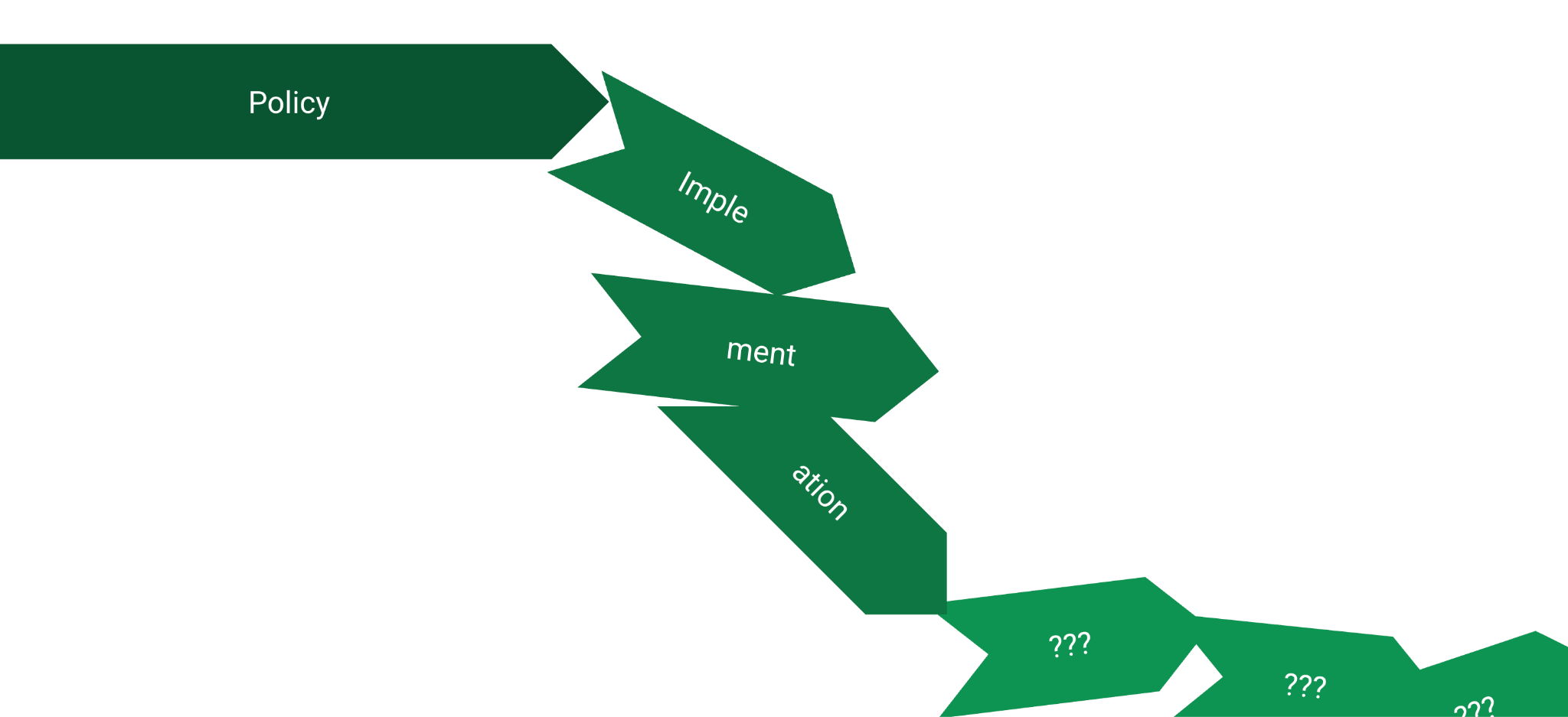
There are a lot of reasons for this state of affairs. One is that our lawmakers tend to stop paying attention once the political work is done. The “magic words” of law and policy are spoken (or rather written, debated, and then passed or adopted) and then the calendar, the press, the advocacy community, and the reelection incentive all point towards the next issue. Understanding what’s actually happening because of new law tends to be seen as the purview of auditors’ and analysts’ offices, who do important work, but are an arm’s length from the electeds who should care the most about whether the outcome was achieved, and are the best positioned to do something about it if it wasn’t.
Last November, I wrote about an experiment in the California Assembly designed to change that. Speaker Robert Rivas launched a pilot called Outcomes Reviews: a structured process by which a legislator and their staff publicly commit to reviewing a law they championed, spend months meeting with the people the law actually affects and researching the outcomes, and then announce what they learned and what they’re going to do about it. Earlier this week, his office announced the results of the pilot year. Fifteen Assemblymembers reviewed fourteen laws, covering housing, energy, health care, foster care, wildfire recovery, and more. According to the Speaker’s office, the program will continue next session, with more members and more reviews, on its way to becoming a permanent part of how Assembly policy teams work.
One of the bills is AB 2316, passed in 2022, authored by Assemblymember Chris Ward of San Diego to create a community solar program for the state. Community solar is a simple idea: if you own a home with a sunny roof, you can put panels on it and watch your utility bill shrink, but nearly half of California households rent. Some owners are boxed out too, by roofs that are shaded, structurally unsuitable, or attached to condos. Community solar lets those people subscribe to a share of a mid-sized solar project nearby and get credit on their bills for the power it produces. Programs like this are how renters and lower-income families already save money on their bills and reduce their carbon footprints in twenty-two states and the District of Columbia. California, the state that practically invented solar, doesn’t really have this, which is why AB 2316 attracted the kind of coalition you rarely see: the solar industry, labor, consumer advocates, environmental groups, and legislators from both parties.
The law directed the California Public Utilities Commission to stand up a program by July 2024, with at least half its capacity reserved for low-income subscribers. The coalition proposed a financing mechanism, worked out in detail, that would pay projects enough to actually get built. In May 2024, the CPUC rejected it and instead adopted a program that looks a lot like what the state’s three big investor-owned utilities wanted, compensating projects at roughly wholesale rates. No other state’s program works this way, for a reason developers have been very clear about: you cannot finance a project on those rates. The commission also blew past its statutory deadline, and leaned on a one-time $249 million federal Solar for All grant to make the numbers look workable — a grant the Trump administration has since (predictably) canceled.
So four years after the bill signing, there is not a single new community solar project because of this law. There is not a single renter in California whose utility bills are shrinking, and zero environmental benefit.
Ward, to his enormous credit, was not going to let this result stand, but the author of a law that an agency has essentially nullified traditionally has few good options. Re-litigating your own bill looks like an admission of failure, there’s no obvious venue for it, and the media and advocacy ecosystem doesn’t know how to engage, so there’s little incentive for an elected whose career depends on attention. In this case, however, Ward could sponsor an Outcomes Review. In February, the Assembly Utilities and Energy Committee held a hearing on what had become of AB 2316, assembling the whole record in one place: what the legislature intended, what the commission did instead, and what got built (or rather, didn’t). His team was able to follow a known, predictable cadence of activity that was built into the institutional calendar, and that press, stakeholders, and advocates could easily follow.
In this case, the result was in fact a new bill. AB 1813 is largely the same as AB 2316 but without the wiggle room: it requires the CPUC to amend its program to meet the original intent of the law. It cleared its policy committee unanimously, passed the Assembly, and is now pending on the Senate floor. The commission, for its part, finalized its version of the program in June, largely unchanged. So this is now a standoff between a legislature and its own regulator, and Ward — now armed with a clear public record — is refusing to back down.
Steve Teles has a name for the underlying dynamic: minoritarianism, the pattern by which small groups with intense preferences and procedural fluency beat broad majorities with better claims but worse lawyers. His classic examples focus on citizen voice — the neighbors who show up to kill the apartment building. In this case, it’s the opposite: the public-facing process, the coalition and the votes and the hearings, all favored community solar. What blocked it was a venue insulated from all that, where the three big investor-owned utilities in California know the terrain intimately and the renters who would have saved money on their bills are nowhere to be seen.
To be fair to the commission, it has an argument: paying community solar projects above wholesale rates can shift costs onto everyone else’s bills, the same concern that drove the rooftop solar fights. That’s a legitimate policy question that involves tradeoffs that someone has to decide between. But the legislature, made up of people elected to represent Californians, chose to decide it. The author and the coalition behind the law were clear about the financing mechanism they wanted. But (presumably) in the interests of not locking in a particular program design should a better one be proposed, the authors also told the commission to create a program if it found the program beneficial. That wiggle room allowed the critical decisions to get made in a venue where the utilities’ interests ultimately dominated. The new law Ward has sponsored takes that choice back.
Outcomes Review is an experiment, designed to answer a few questions. First do the reviews actually identify problems? The answer, from what I can tell, seems to be yes. But this program is also trying to change assemblymembers’ incentives to stick with the issues and resolve these problems instead of just moving on. To do that, we need to know if advocates and the press engage with Outcomes Reviews the way they do with new bills, because they influence the behavior of electeds. During the pilot, according to the Speaker’s office, advocates and community organizers began approaching member offices to ask legislators to sponsor Outcomes Reviews on laws they care about. That’s a sign that the infrastructure that surrounds lawmaking — the advocates, the stakeholders, the people who generate the attention that generates reelection — is starting to organize around follow-through, not just passage. That was the idea from the beginning: give legislators the same sequence of public moments for making laws work that they get for making laws, and maybe the incentives will start to shift. Early signs here are encouraging.
The Outcomes Reviews conducted in this first round found a good range of outcomes: a law that’s mostly working (telehealth expansion, which providers say has meaningfully improved access), laws that need refinement (AB 2011, the housing streamlining law, works well for 100% affordable projects and less well for mixed-income ones), and laws that weren’t working at all. Community solar was one; the FAIR Plan clearinghouse was another. The FAIR Plan is California’s insurer of last resort — expensive, bare-bones coverage for homeowners the regular market won’t touch — and as insurers have fled wildfire risk it has swelled past 570,000 policies. A 2020 law created a clearinghouse that was supposed to give regular insurers a way to find FAIR Plan policyholders and offer to take them back. Assemblymember Lisa Calderon’s review found that in its first four years, the clearinghouse moved 730 households back into the regular market, and just eleven insurers had signed up to participate. At 570,000 policies, that’s about one-eighth of one percent over four years. Many homeowners had no idea the program existed at all. I can personally confirm that finding. I’m a FAIR Plan customer, and this review was the first I had ever heard of the law or the program it mandated. Calderon’s fix-it bill, AB 69, requires that offers actually reach the policyholder instead of dying somewhere with a broker, and that people on the FAIR Plan get told that alternatives exist. It’s pending on the Senate floor. We’ll see what happens.
A fair question is how Outcomes Reviews differ from plain old fashioned oversight. In a sense, they are plain old fashioned oversight, the kind we’ve drifted away from. What oversight has become is hearings that get convened because something has visibly caught fire, and legislators have to perform blame finding. I saw this in action in California in the hearings over the pandemic unemployment insurance crisis, and I saw the way the agency leadership and staff reacted, which was to arm themselves with evidence of adherence to procedure and lock down anything that deviated from the norm, despite the fact that the norm was clearly causing the problem. What public servants are saying when they do that, in not so many words, is “yes, this sucks but it sucks because you made us do it this way.” They have a point, but the time to make that point is not during a televised hearing when everyone is trying for a viral clip. We need to build the muscle for saying that when things aren’t on fire. Outcomes Reviews could be an important venue for that kind of debugging. When things work well, it’s usually not because they were designed perfectly, but because they are constantly being debugged. We could use a whole lot more debugging muscle, which means a lot more low-temperature venues for feeding back to the legislature what’s making implementation so hard.
When my book came out in 2023, I was asked to come to Sacramento and speak to legislators there. When I explained that my book was about ensuring that law and policy had its intended effect, a shocking number of elected officials told me without any shame that they rarely even knew what real world effect the laws they passed had had. Now Speaker Rivas is saying loudly and clearly that passing a law isn’t the finish line, and the pilot year suggests his chamber is starting to believe it. There will be an annual report this fall and a plan for scaling the program in 2027. It’s still early, but this is one experiment I’m going to keep watching.
So why isn't it routinely the case that a new law, especially one which gives some level of implementation discretion to an unelected agency, is outcomes-tied from the start? That is, why doesn't the legislature define an outcome or set of outcomes (like X more households on community solar per year, Y cost constraints, etc) and direct the agency in its legislation to manage toward that outcome, and mandate a review period after which the law sunsets if it isn't achieving that outcome? This is much more like the way successful private sector organizations operate (think KPIs) and it would systematize the good effects of these reviews much more thoroughly than this sample pilot program. What stands in the way of future California laws being written like this?
"To be fair to the commission, it has an argument: paying community solar projects above wholesale rates can shift costs onto everyone else’s bills, the same concern that drove the rooftop solar fights. That’s a legitimate policy question that involves tradeoffs that someone has to decide between."
I am looking forward to the outcomes review in a decade or so when the legislature learns that the CPUC and the evil IOUs were correct about this. Maybe then legislators will finally realize the difference between (1) lowering the underlying costs of building and operating the grid and (2) shifting those costs between customers. Probably wishful thinking on my part.
Regardless, I appreciate the spirit of Speaker Rivas' Outcomes Reviews. This is excellent!